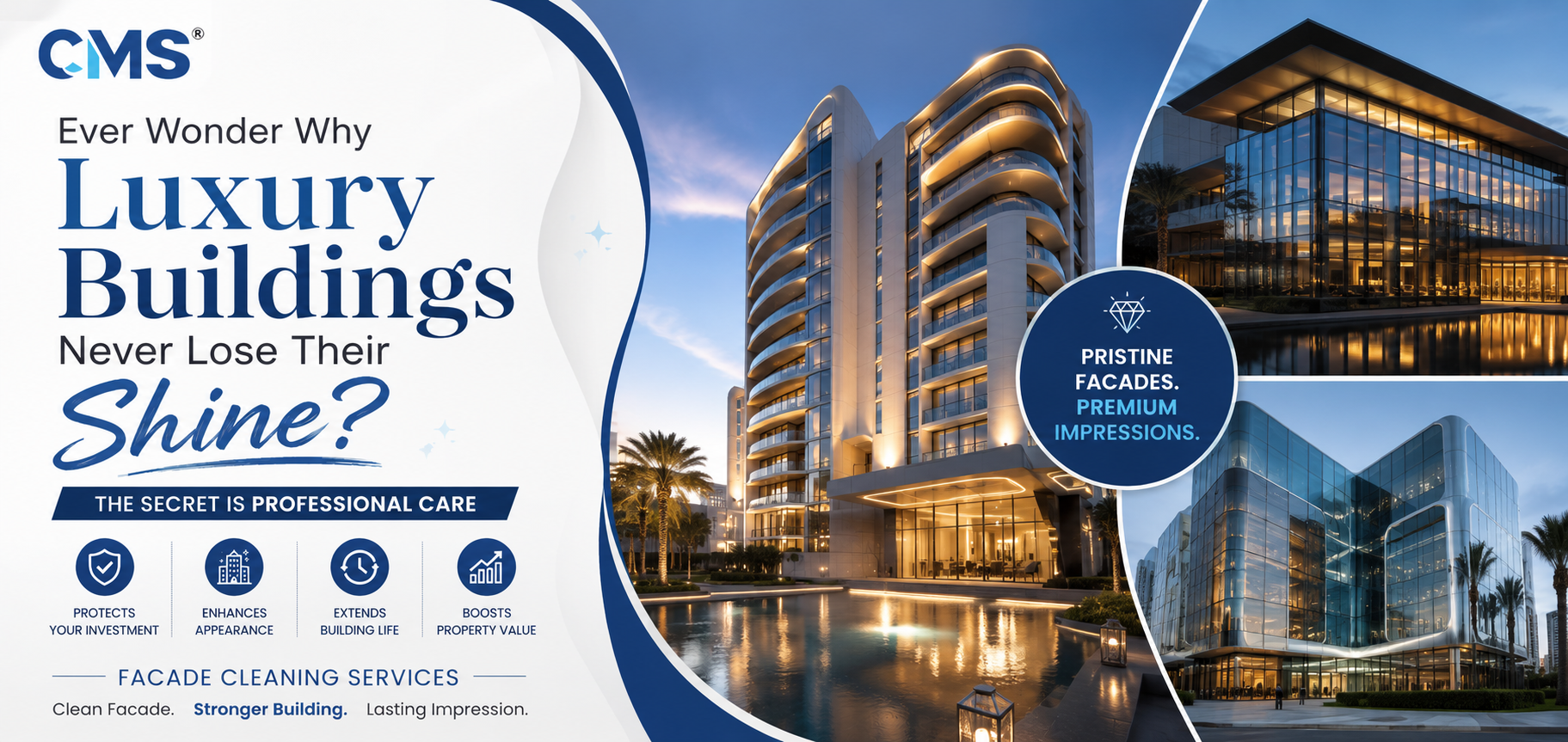
Walk past any glass tower in Gurgaon’s Cyber Hub or a five-star hotel on Delhi’s Aerocity strip. You’ll notice something: the glass gleams, the steel doesn’t streak, and the stone never looks tired. That’s not an accident of good architecture. It’s the result of scheduled, professional facade cleaning services. Luxury buildings never lose their shine because a trained crew is quietly working on a maintenance calendar you never see, using techniques ranging from pressurised water systems to rope access and specialised chemical treatments. In short, the “secret” is consistency, not magic. And it’s a service every commercial and residential building in Delhi NCR can access.
What Is Facade Cleaning and Why Is It Important?
Facade cleaning is the process of removing dust, soot, grime, and pollutant build-up from a building’s exterior surface. This applies whether that surface is glass, steel, concrete, or stone. It’s often mistaken for a cosmetic exercise, but it’s closer to preventive maintenance. A facade is the building’s first line of defence against weather, pollution, and structural decay.
An unclean, streaked, or moss-covered exterior does two things at once. It damages first impressions for visitors, tenants, and customers, and it slowly corrodes the material underneath. Left untreated, pollutants can eat into sealants and weaken joints. Over time, this shortens the working life of the facade by years. Regular facade cleaning services protect the investment a building represents, not just its looks.
The Real Enemies of a Building’s Facade
Every facade in a city like Delhi NCR is fighting a daily, invisible battle. Understanding the enemy helps explain why professional intervention matters so much.
- Dust and construction particulate — Delhi NCR’s ongoing construction boom means airborne dust settles on every exposed surface. It embeds itself into grout lines and glass seals.
- Vehicular soot and industrial emissions — Diesel exhaust and industrial fallout leave a fine black film. This dulls glass and stone alike.
- Moss and algae growth — Damp corners and shaded facades develop moss. This retains moisture and accelerates material breakdown.
- Acid rain and monsoon runoff — Seasonal rain in North India carries acidic pollutants. These etch into softer stone and metal cladding over time.
- Bird droppings and organic staining — Left uncleaned, these are mildly corrosive. They also attract further biological growth.
None of these threats are dramatic on their own. But compounded over months without cleaning, they’re what separates a building that looks five years old from one that looks fifteen.
How the World’s Most Iconic Buildings Stay Spotless
If you want proof that even the most prestigious buildings need a dedicated facade cleaning routine, look at the Burj Khalifa in Dubai — the world’s tallest building. Cleaning its roughly 24,000 glass panels is not a one-time job. It takes a specialised crew, historically reported to be around 36 to 120 workers depending on the operation phase. A single cleaning cycle takes roughly two to three months, using building maintenance units, rope access, and telescopic booms. The process restarts almost as soon as it finishes.
This isn’t unique to Dubai either. Skyscrapers like London’s Shard and Kuala Lumpur’s Petronas Towers run similar recurring facade maintenance programs. They use a mix of gondola systems, rope access, and building-integrated cleaning tracks. The common thread across every landmark building is simple: cleaning isn’t scheduled around convenience. It’s scheduled around exposure, material, and climate, then repeated indefinitely.
That level of commitment isn’t reserved for record-breaking skyscrapers. It reflects a universal principle: any building that wants to look premium needs a planned, recurring facade cleaning schedule, matched to its height, material, and local climate. A 10-storey commercial tower in Gurgaon and the Burj Khalifa are solving the same problem at different scales. Dust, grime, and weather don’t care how tall your building is.
Facade Cleaning vs. Ignoring It: What’s Actually at Stake
It’s easy to treat facade cleaning as a “nice to have” line item in a facility budget. In practice, it behaves more like insurance. A glass panel with embedded grime doesn’t just look dull. The trapped particulate can scratch the surface every time rain or wind moves across it, permanently dulling the finish over years. A concrete facade with unchecked moss retains moisture against the surface. In Delhi NCR’s humid monsoon months, this can accelerate cracking and efflorescence — the white, chalky mineral deposits that signal water is moving through the material.
There’s also a financial angle facility managers often underweight: property valuation and tenant retention. Commercial tenants, mall operators, and hotel brands routinely cite building appearance as part of their site-selection criteria. A well-maintained facade signals a well-run building overall. This indirectly supports higher occupancy and rental rates. Deferred facade maintenance, on the other hand, tends to show up later as a larger repair bill. Think replaced sealant, corroded metal cladding, or stone repointing after years of acidic runoff.
None of this requires guesswork. It requires a facade cleaning partner who treats cleaning as scheduled maintenance rather than a one-time cosmetic fix.
Facade Cleaning Methods That Keep Buildings Gleaming
Not every facade responds to the same treatment. Professional providers assess the material, the type of staining, and the building’s access constraints before choosing a method.
Water-Based Cleaning
This is the least invasive approach and the most commonly used for regular maintenance. It includes simple washing, soaking, and pressure-washing with hot water or steam. Pressure-washing typically applies water at 100 to 400 psi. This is especially effective for facades with heavy dirt accumulation, such as buildings near construction zones or busy roads. It’s gentle enough for frequent use without damaging most surfaces.
Chemical Cleaning
Tougher stains need a more targeted approach. Think old paint, hardened grime, biological growth, or stubborn coatings. This involves carefully selected acidic cleaners, alkaline cleaners, organic solvents, or non-sudsing detergents, matched precisely to the facade material to avoid discolouration or surface damage. This is where experience matters most: the wrong chemical on the wrong surface can cause more harm than the dirt itself.
Specialised Access Techniques
For buildings where the facade isn’t reachable through conventional means, professional crews use elevated work platforms, rope access, high wall creepers, and telescopic instruments. This makes it possible to clean glass, steel, and concrete facades at virtually any height, safely and thoroughly.
DIY Cleaning vs. Professional Facade Cleaning Services
Some building owners consider handling facade cleaning in-house, especially for smaller, low-rise properties. It’s worth understanding where that approach works and where it doesn’t.
Where DIY can work:
- Ground-floor storefronts or single-storey structures with easy access
- Light dust removal on a frequent basis, between professional deep cleans
- Basic water-and-soap washing on durable, non-sensitive surfaces
Where professional cleaning is the safer choice:
- Any building above two or three storeys, where height-work safety regulations apply
- Glass curtain walls, where the wrong pressure or cleaning agent can cause permanent streaking
- Stone, marble, or heritage facades that require specific, non-abrasive treatment
- Buildings needing rope access, cradles, or elevated platforms
- Situations involving moss, algae, or chemical stain removal
The risk with DIY facade cleaning isn’t just safety. Untrained cleaning attempts often use the wrong pressure level or an incompatible chemical, which can strip protective coatings or etch glass permanently. What looks like a cost-saving shortcut can end up being a far more expensive repair.
Facade Cleaning Services in Delhi NCR: Delhi, Noida, Gurgaon and Ghaziabad
Delhi NCR presents a unique challenge for facade maintenance. It’s one of the fastest-developing urban regions in the world. Dense construction activity, high vehicular pollution, and a distinct monsoon-and-dust cycle combine in ways most cities don’t deal with together.
- Facade cleaning services in Delhi are in high demand across corporate hubs, malls, and high-rise residences where pollution and dust accumulate quickly.
- Facade cleaning services in Gurgaon are especially critical for the glass-heavy towers of Cyber City and Golf Course Road, where reflective facades show streaks and grime far more visibly than stone or brick.
- Facade cleaning services in Noida cater to the growing number of commercial complexes and residential high-rises along the Noida-Greater Noida Expressway.
- Facade cleaning services in Ghaziabad are increasingly sought after as the city’s skyline grows with new commercial and mixed-use developments.
Across all of Delhi NCR, the underlying need is the same. Buildings that face constant dust, construction runoff, and seasonal weather require a facade cleaning partner who understands local conditions, not a generic, one-size-fits-all cleaning schedule.
The Environmental Angle: Why Green Facade Cleaning Matters
Sustainability is increasingly part of the facade cleaning conversation, and not just as a buzzword. Traditional cleaning at scale can use significant amounts of water and harsh chemicals. Both have downstream environmental costs, particularly relevant in a water-stressed region like Delhi NCR.
Green cleaning programs address this in a few concrete ways. These include using biodegradable, non-toxic cleaning agents wherever possible, adopting water-efficient pressure systems rather than high-volume flooding techniques, and ensuring runoff doesn’t carry chemical residue into stormwater drains. For building owners pursuing green certifications or sustainability targets, the facade maintenance vendor they choose is part of that scorecard, not a side detail.
Providers with environment-friendly Green Clean programs let commercial buildings maintain their appearance without working against their own sustainability commitments. This is an increasingly common requirement from corporate tenants and ESG-conscious ownership groups.
Signs Your Building’s Facade Needs Professional Attention
Most facilities managers don’t need a technical audit to know cleaning is overdue. A few visible cues usually say it all.
- Visible streaking or a dull, hazy appearance on glass panels
- Dark patches or discolouration on stone or concrete surfaces
- Moss or algae forming in shaded or damp corners
- A noticeable difference in shade between cleaned and uncleaned sections
- Recurring complaints from tenants, visitors, or residents about the building’s appearance
If any of these sound familiar, it’s usually cheaper, and safer, to schedule professional facade cleaning services now. Waiting only lets the damage become structural.
How Often Should a Building Facade Be Cleaned?
There’s no single answer here; it depends on location, material, and exposure. As a general guideline:
| Building Type | Recommended Cleaning Frequency |
|---|---|
| Glass-facade commercial towers (high pollution zones) | Every 2–3 months |
| Stone or concrete facades | Every 6 months |
| Residential buildings, lower exposure | Every 6–12 months |
| Buildings near construction zones | Monthly spot cleaning + quarterly deep clean |
A facility manager in a high-dust corridor like NH-8 in Gurgaon or the Noida Expressway will typically need a tighter cleaning cycle. Buildings in quieter residential pockets can usually stretch that timeline further.
What to Expect From a Professional Facade Cleaning Visit
For building owners who haven’t gone through the process before, a structured visit typically follows a predictable flow:
- Site assessment — A team evaluates facade material, height, access points, and the extent of staining or damage.
- Method selection — Based on the assessment, the crew chooses between water-based cleaning, chemical treatment, or a combination, along with the right access equipment.
- Safety setup — Elevated platforms, rope access rigs, or building maintenance units are installed with full safety checks before any work begins.
- Cleaning execution — The facade is cleaned section by section, usually top-to-bottom, to avoid re-soiling already cleaned areas.
- Quality inspection — A supervisor reviews the completed sections against the original assessment to confirm consistency and coverage.
- Maintenance recommendation — Most providers suggest a cleaning frequency going forward, based on the building’s exposure and material.
This structured approach is what separates professional facade cleaning from an ad-hoc wash. It treats the facade as part of the building’s ongoing maintenance system, not a one-time task.
Why Choose Classic Maintenance Services for Facade Cleaning
Classic Maintenance Services has spent more than a decade delivering facility maintenance and cleaning services across corporate, retail, government, and residential properties in Delhi NCR. A few things set the approach apart:
- Trained, safety-first crews — every technician working at height follows strict safety protocols to protect both personnel and the building surface.
- The right method for the right surface — glass, steel, and concrete facades are each treated with techniques suited to their material, not a generic wash.
- Full-height access capability — using elevated platforms, rope access, high wall creepers, and telescopic instruments, no facade is out of reach.
- Beyond cosmetic cleaning — the process also helps prevent erosion, damp spots, moss growth, and damage from frost, acid rain, and moisture.
- Proven consistency — a 95%+ customer retention rate reflects the reliability clients experience across repeat engagements.
Whether it’s a single office tower or a multi-building commercial campus, the goal stays the same: a facade that looks as good on day 1,000 as it did on day one.
Frequently Asked Questions
1. What is included in professional facade cleaning services?
Professional facade cleaning typically includes assessment of the surface material, dust and grime removal using water-based or chemical methods, moss and algae treatment, and access solutions like rope access or elevated platforms for hard-to-reach areas.
2. How much does facade cleaning cost in Delhi NCR?
Cost depends on building height, facade material, level of staining, and access complexity. Most providers, including Classic Maintenance Services, offer a site visit and custom quote rather than a flat rate.
3. Is facade cleaning safe for glass buildings?
Yes, when done correctly. Water-based pressure washing is the standard, least invasive method for glass facades. Chemical treatments are only used for stubborn stains, with agents matched to the glass and its seals.
4. How long does it take to clean a building’s facade?
It varies by size. A mid-rise commercial building may take a day or two. Very tall or complex structures can take weeks, similar to how iconic skyscrapers require ongoing, cyclical cleaning schedules.
5. Can facade cleaning damage the building’s exterior?
Not when handled by trained professionals. Damage typically occurs when the wrong chemical or pressure level is used on a sensitive surface, which is why matching the method to the material is critical.
6. How often should commercial buildings clean their facade?
High-exposure buildings near construction or traffic corridors generally need cleaning every 2–3 months. Lower-exposure buildings can go 6–12 months between cleanings.
7. What’s the difference between water-based and chemical facade cleaning?
Water-based cleaning (washing, soaking, pressure-washing) handles routine dirt and dust. Chemical cleaning targets tougher stains, coatings, or biological growth using agents matched specifically to the facade material.
8. Do facade cleaning services cover high-rise buildings?
Yes. Professional providers use elevated work platforms, rope access, high wall creepers, and telescopic instruments to safely clean facades at virtually any height.
9. What materials can be cleaned — glass, steel, concrete?
All of them. Glass, steel, and concrete facades each require different techniques and cleaning agents. Experienced providers adjust their approach accordingly.
10. Why do luxury buildings always look freshly cleaned?
Because they follow a strict, recurring maintenance schedule. Even the tallest buildings in the world, like the Burj Khalifa, run continuous cleaning cycles rather than one-off cleanings.
11. Does facade cleaning help prevent long-term building damage?
Yes. Regular cleaning removes pollutants before they corrode materials, prevents moss-related moisture damage, and protects against acid rain and frost-related erosion.
12. Which areas in Delhi NCR offer professional facade cleaning services?
Facade cleaning services are widely available across Delhi, Noida, Gurgaon, and Ghaziabad. Providers like Classic Maintenance Services serve commercial and residential buildings throughout the region.
13. How do I choose the right facade cleaning company?
Look for trained and insured crews, experience with your specific facade material, proper safety certifications for height work, and a track record of client retention. These are all signs of a dependable service provider.
Final Thoughts
Luxury buildings never lose their shine because someone is making sure of it, on a schedule, with the right tools and technique for that specific facade. Whether you manage a glass tower in Gurgaon, a stone-clad office in Delhi, or a residential high-rise in Noida or Ghaziabad, the principle stays the same. It’s the one that keeps the world’s tallest buildings gleaming: consistent, professional facade cleaning services.
Classic Maintenance Services brings over a decade of facility maintenance experience to buildings across Delhi NCR, with trained crews, the right equipment for every surface, and a process built to protect both appearance and structural longevity. If your building’s facade is due for attention, a professional assessment is the simplest first step toward getting that shine back.