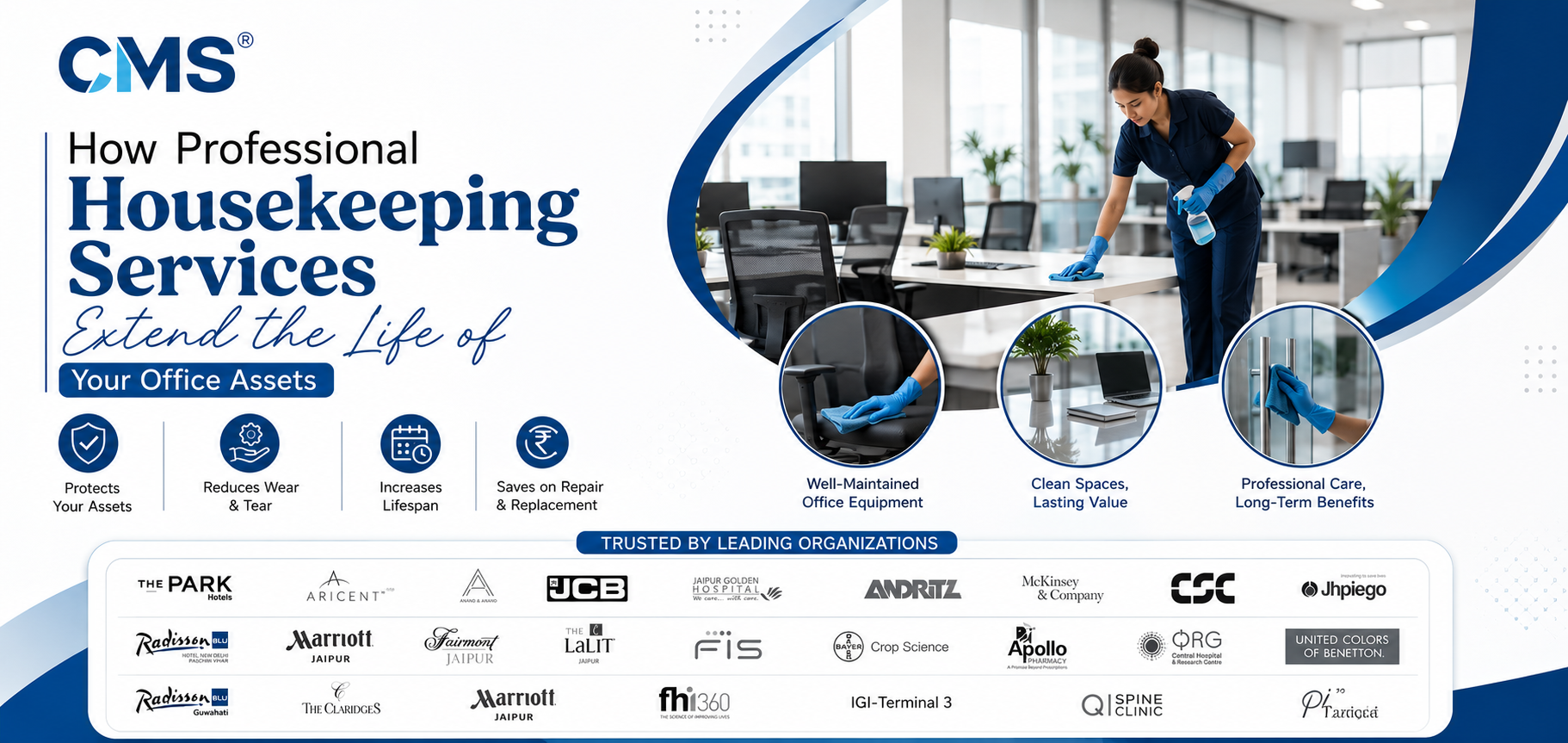
Professional housekeeping services extend the life of your office assets by removing the dust, grime, and moisture that quietly wear down flooring, furniture, carpets, and electronics every single day. Left unchecked, these everyday contaminants scratch surfaces, clog machinery, and force early replacements — turning what looks like a routine cleaning cost into one of the biggest hidden savings a business can make. In short: regular, professional cleaning isn’t a cosmetic expense. It’s asset protection.
The Real Problem: Office Assets Wear Out Faster Than Anyone Notices
Most facility managers track big-ticket maintenance — HVAC servicing, lift inspections, fire safety checks. Far fewer track the slow, invisible damage caused by inconsistent cleaning. Dust doesn’t just sit on a desk looking untidy. It works its way into keyboard mechanisms, settles into carpet fibers where it acts like sandpaper underfoot, and builds a film on glass and chrome that, over months, becomes near-impossible to fully restore.
This is the one problem this article focuses on: how the presence or absence of consistent, professional housekeeping directly determines how long your office assets last — and what that means for your replacement and repair budget over time. It’s not about whether your office looks clean on a Monday morning walkthrough. It’s about whether your flooring is still presentable in three years, or needs replacing in one.
What Counts as an “Office Asset” Here?
When people think of office assets, they usually picture laptops and furniture. But from a housekeeping standpoint, the list is much longer — and each item degrades differently depending on how it’s cleaned and maintained.
| Asset Category | Examples | How Poor Cleaning Damages It |
|---|---|---|
| Flooring | Tile, marble, hardwood, carpet | Grit acts as an abrasive; stains set in permanently; carpet fibers break down |
| Furniture | Desks, chairs, cabinets, sofas | Dust buildup, upholstery staining, wood finish dulling |
| Glass & Fixtures | Windows, partitions, light fixtures | Film buildup reduces natural light; hard water spots etch glass over time |
| Electronics | Keyboards, monitors, AC vents, printers | Dust accumulation causes overheating and mechanical failure |
| Restroom Fixtures | Sinks, toilets, fittings | Mineral deposits and grime cause corrosion and permanent discoloration |
| Carpets & Upholstery | Office carpets, sofas, cushioned chairs | Ground-in dirt and moisture cause fiber breakdown and odor retention |
| HVAC & Vents | Ducts, filters, vents | Dust buildup reduces efficiency and shortens equipment lifespan |
Once you look at the full list, the connection becomes obvious: housekeeping services aren’t just about appearances. They’re routine maintenance for nearly everything a business has invested in.
How Inconsistent Cleaning Quietly Costs You More
Here’s where the real financial impact shows up. Skipping or under-scheducing professional housekeeping services doesn’t save money — it defers a cost and usually makes it bigger.
What tends to happen without consistent professional housekeeping:
- Carpets and upholstery trap dirt at the fiber level, requiring replacement years earlier than their rated lifespan
- Hardwood and laminate flooring loses its protective finish faster, exposing the material underneath to moisture damage
- Glass partitions and windows develop etching from mineral deposits that no amount of later cleaning can remove
- Electronics accumulate dust internally, leading to overheating, slower performance, and shorter working life
- HVAC filters and vents clog with airborne dust, forcing the system to work harder and wear out sooner
- Restroom fixtures corrode from mineral buildup, requiring replacement rather than simple refinishing
Illustrative cost comparison: neglect vs. consistent housekeeping
| Asset | Typical Lifespan With Consistent Housekeeping | Typical Lifespan With Inconsistent Cleaning |
|---|---|---|
| Office carpet | 7–10 years | 3–5 years |
| Hardwood/laminate flooring | 10–15 years | 5–8 years |
| Upholstered furniture | 5–8 years | 2–4 years |
| Glass partitions & fixtures | Long-term with minimal etching | Early replacement due to permanent staining |
| HVAC filters/vents | Standard service intervals maintained | More frequent servicing and part replacement |
These figures are illustrative rather than fixed guarantees — actual lifespan depends on foot traffic, material quality, and the specific cleaning routine used. But the direction of the pattern holds consistently across office environments: assets cleaned as part of a structured, professional program simply last longer.
The ROI Math: Cleaning Cost vs. Replacement Cost
It helps to put this in plain financial terms. A recurring housekeeping contract is a monthly line item that is budgeted for and predictable. Replacing carpet, refinishing flooring, or swapping out furniture ahead of schedule is an unbudgeted capital expense that usually arrives at the worst possible time — right when a lease renewal, office move, or client visit is already putting pressure on the budget.
| Scenario | Ongoing Cost | Unplanned Cost |
|---|---|---|
| Consistent professional housekeeping | Predictable monthly or annual service fee | Minimal — assets reach their expected lifespan |
| Inconsistent or in-house-only cleaning | Lower visible spend upfront | Early carpet replacement, refinishing, furniture reupholstering, HVAC part replacement |
The pattern that shows up again and again in facilities management is simple: the cost of consistent housekeeping services is almost always smaller than the cost of the early replacements that follow when it’s skipped. A carpet replaced two years early, a set of office chairs reupholstered ahead of schedule, or an HVAC system serviced more frequently than it should need to be — each of these costs more, in a single event, than months of a structured housekeeping contract would have.
There’s also a less obvious cost: disruption. Replacing flooring or furniture means moving people, shutting down sections of an office, and coordinating vendors — all things a well-run housekeeping program helps you avoid entirely by preventing the damage in the first place.
Housekeeping Services and Everyday Productivity
Asset protection isn’t the only return on a structured housekeeping program — there’s a people side to this too. Dust and allergens that build up on carpets, vents, and surfaces don’t just wear down materials; they affect indoor air quality and, in turn, employee comfort and focus. A workspace that’s consistently maintained through professional housekeeping tends to see fewer complaints about stuffy air, dusty desks, or grimy shared spaces — all small frictions that add up over a working week.
This is a secondary benefit rather than the main financial case, but it’s worth factoring in: a well-maintained office isn’t just an asset-protection strategy, it’s part of how a workplace feels to the people using it every day. Clients and visitors notice it too, particularly in reception areas, meeting rooms, and washrooms, where first impressions form quickly.
What Professional Housekeeping Services Really Do Differently
The gap between “someone wiping surfaces occasionally” and a structured housekeeping program comes down to method, tools, and consistency — not just effort.
Core service components that protect assets over time:
- Vacuuming — Deep-cleaning tile, hardwood, carpets, and upholstery with equipment strong enough to lift embedded grit before it can grind into fibers and finishes
- Dusting — Covering picture frames, cabinets, countertops, light fixtures, fan extensions, window sills, and railings using microfiber tools that trap fine particles instead of scattering them
- Mopping — Matching the cleaning method to the floor type, whether concrete, hardwood, tile, marble, or granite, to avoid using the wrong product on a delicate surface
- Sanitizing and disinfecting — Targeting high-touch, high-grime areas like restrooms, kitchen counters, and doorknobs to prevent buildup that leads to corrosion and staining
- Wipe-downs — Regularly cleaning sinks, showers, mirrors, stoves, and cabinets so grime doesn’t have time to bond to the surface
- Litter clearing — Removing waste properly and separating recyclables, keeping common areas free of the residue that attracts pests and stains flooring
Each of these tasks, done on a consistent schedule, is what actually protects the assets underneath — not a single deep clean once a quarter, but a structured rhythm that never lets grime, moisture, or dust get the chance to do lasting damage.
The Tools Behind the Results
The equipment and products used make a measurable difference to how well office assets are protected. A professional housekeeping service typically relies on industrial-grade tools sourced from established brands — names like DIVERSEY, ROOTS, UNGER, and KARCHER are common in commercial cleaning — rather than the consumer-grade tools used for casual upkeep.
Just as important is what’s inside the bottle. Non-toxic, eco-friendly cleaning and sanitizing products — floor cleaners, glass cleaners, and surface disinfectants — clean effectively without leaving behind the chemical residue or corrosive buildup that can degrade certain surfaces over time. This matters directly for asset longevity: harsh, inappropriate products can do as much damage as no cleaning at all, especially on marble, wood finishes, and metal fixtures.
Housekeeping Services Across Different Office Environments
Not every workplace has the same asset-protection priorities, and a good housekeeping program adjusts accordingly.
| Environment | Priority Assets | Cleaning Focus |
|---|---|---|
| Corporate offices | Carpets, desks, glass partitions, electronics | Daily dusting and vacuuming, scheduled deep cleans |
| Commercial buildings | Lobbies, elevators, common area flooring | High-traffic zone protection, frequent mopping |
| Hospitals & clinics | Fixtures, floors, equipment surfaces | Sanitization-first approach, hospital-grade disinfectants |
| Manufacturing units | Floors, machinery-adjacent surfaces | Debris and dust control to protect equipment |
| Educational institutes | Furniture, restrooms, common areas | Durable, frequent cleaning cycles suited to heavy use |
| Retail spaces | Flooring, display fixtures, glass | Appearance-first cleaning that also protects finishes |
Whatever the setting, the underlying principle stays the same: matching the housekeeping approach to the specific assets in that environment protects them better than a generic, one-size-fits-all routine.
How Classic Maintenance Services Approaches Office Asset Protection
Classic Maintenance Services builds its housekeeping programs around this exact idea — that cleaning is asset protection, not just appearance management. The approach typically includes:
- Needs assessment – Understanding which assets in your space need the most protection, whether that’s flooring, furniture, or equipment
- Custom cleaning plan – A schedule built around your specific office type, not a generic checklist
- Trained, professional teams – Staff trained to use the right method for each surface, from marble to upholstery
- Branded, industrial-grade tools – Equipment from trusted names like DIVERSEY, ROOTS, UNGER, and KARCHER
- Eco-friendly products – Non-toxic cleaners that protect surfaces without leaving damaging residue
- Flexible scheduling – Daily, weekly, or monthly plans depending on how your space is used
This is available not just in Delhi, but across Gurgaon and Noida as well, for corporate offices, commercial buildings, hospitals, manufacturing units, and educational institutes alike. The goal isn’t just a clean-looking office on the day of the visit — it’s a structured program that protects the investment already sitting inside your walls.
How to Make Your Office Assets Last Longer
Whether you manage the cleaning in-house or through a professional housekeeping service, these habits help protect your assets further:
- Match cleaning products to surface type. The wrong product on marble or wood finish can cause more damage than no cleaning at all.
- Don’t skip HVAC and vent cleaning. Clogged filters shorten equipment life and reduce air quality at the same time.
- Set a consistent schedule, not a reactive one. Cleaning only when a space “looks dirty” means damage has already started.
- Protect high-traffic zones specifically. Entryways, lobbies, and shared kitchens wear out faster and deserve more frequent attention.
- Review your cleaning contract periodically. As your office assets age or your space changes, your housekeeping plan should adjust too.
- Document asset condition over time. A simple quarterly photo log of flooring, furniture, and fixtures makes it easier to spot early wear and adjust the cleaning plan before damage sets in.
- Ask your provider about product compatibility. Not every cleaning product suits every surface — a quick conversation about your specific flooring, upholstery, and fixtures can prevent avoidable damage down the line.
Indications That Your Present Cleaning Practice Isn’t Safeguarding Your Property
Before assuming a housekeeping upgrade is needed, it helps to check for early warning signs. These are the patterns facility teams typically notice first, well before any major damage becomes obvious:
| Warning Sign | What It Usually Means |
|---|---|
| Carpets look dull even right after cleaning | Ground-in dirt has reached the fiber base, not just the surface |
| Glass partitions develop a permanent haze | Mineral deposits have started etching the surface |
| Furniture upholstery feels gritty or stained | Dust and grime have settled below the surface fibers |
| Restrooms smell even after cleaning | Grime buildup in fixtures has moved past surface-level residue |
| AC vents show visible dust rings | HVAC filters and ducts are overdue for a deeper clean |
| Wood or laminate flooring looks patchy | Protective finish is wearing thin in high-traffic zones |
If more than one or two of these sound familiar, it’s usually a sign that the current cleaning routine is keeping up with appearances but not with the underlying maintenance that protects the asset itself. That gap is exactly where professional housekeeping services make the biggest difference — not by cleaning harder in the moment, but by cleaning consistently enough that these patterns never get the chance to set in.
Choosing the Right Housekeeping Provider for Asset Protection
Not every provider approaches housekeeping the same way, and the difference matters when the goal is protecting long-term assets rather than just passing a visual inspection. A few questions worth asking before signing a contract:
- Do they tailor the plan to your specific assets? A generic checklist applied to every client rarely accounts for the difference between, say, marble flooring and industrial carpet tiles.
- What tools and products do they use? Industrial-grade equipment and non-toxic, surface-appropriate products matter more than they might seem to at first glance.
- How do they handle high-value or delicate surfaces? Marble, hardwood, and glass all need different techniques, and a provider should be able to explain their approach for each.
- Is the schedule flexible enough for your space? A retail floor with heavy foot traffic needs a different rhythm than a quiet back office.
- Can they scale across locations? If your business has offices in Delhi, Gurgaon, and Noida, a single provider managing all three consistently avoids the gaps that come from juggling multiple vendors.
Getting these answers upfront is usually a better predictor of long-term asset protection than comparing quotes on price alone.
Frequently Asked Questions
1. What are housekeeping services in an office setting?
Office housekeeping services cover the routine cleaning and maintenance of a workplace, including vacuuming, dusting, mopping, sanitizing, and waste management, all aimed at keeping the space clean, safe, and well-maintained.
2. How do housekeeping services actually extend the life of office assets?
By removing dust, grime, and moisture before they can damage surfaces, professional housekeeping services prevent the slow wear that shortens the lifespan of flooring, furniture, electronics, and fixtures.
3. How often should an office schedule professional housekeeping?
This depends on foot traffic and the type of assets involved, but most offices benefit from daily light cleaning combined with a more thorough deep clean on a weekly or monthly basis.
4. Can poor cleaning products actually damage office assets?
Yes. Using the wrong product on a delicate surface, such as harsh chemicals on marble or wood finishes, can cause more long-term damage than infrequent cleaning.
5. Do housekeeping services cover electronics and equipment?
Yes, dusting routines typically include keyboards, monitors, printers, and similar equipment, since dust buildup inside these devices can cause overheating and reduce their working life.
6. What tools do professional housekeeping services typically use?
Established commercial cleaning brands like DIVERSEY, ROOTS, UNGER, and KARCHER are commonly used, alongside microfiber tools designed to trap fine dust rather than scatter it.
7. Are eco-friendly cleaning products as effective as standard ones?
Yes, non-toxic and eco-friendly products can clean just as effectively while avoiding the chemical residue and corrosive buildup that can shorten the life of certain surfaces.
8. Do housekeeping services help with HVAC and vent maintenance?
Cleaning around vents and filters helps reduce the dust load on HVAC systems, which supports better efficiency and can extend the life of the equipment.
9. What’s the difference between residential and office housekeeping services?
Office housekeeping services are scaled to commercial needs — covering areas like lifts, elevators, workstations, and shared equipment — while residential services focus on home-specific spaces like kitchens and bedrooms.
10. Can housekeeping services be customized for different office types?
Yes, a good provider adjusts the cleaning approach for corporate offices, hospitals, manufacturing units, and educational institutes based on their specific asset-protection priorities.
11. Do housekeeping services help protect flooring specifically?
Yes, matching the cleaning method to the floor type — tile, marble, hardwood, or carpet — prevents the wrong technique or product from wearing down or staining the surface.
12. Is hiring a professional housekeeping service more cost-effective than in-house cleaning long-term?
Often yes, since professional teams use the correct tools and methods consistently, reducing the risk of the asset damage that leads to early repairs or replacements.
13. Does Classic Maintenance Services offer office housekeeping across Delhi NCR?
Yes, Classic Maintenance Services provides housekeeping services across Delhi, Gurgaon, and Noida, for corporate offices, commercial buildings, hospitals, and educational institutions alike.
The Bottom Line
Office assets don’t fail overnight — they wear down gradually, in ways that are easy to overlook until the replacement bill arrives. Consistent, professional housekeeping services address that wear at the source, protecting flooring, furniture, electronics, and fixtures long before damage becomes visible or costly. Treating housekeeping as routine maintenance, rather than a cosmetic extra, is what actually extends the life of everything sitting inside your office.
For businesses weighing whether to invest in structured housekeeping services or continue with ad-hoc cleaning, the asset data tells a consistent story: the small, recurring cost of professional housekeeping services is almost always smaller than the large, unplanned cost of early repairs and replacements. Viewed this way, housekeeping services aren’t an overhead line item to minimize — they’re one of the more straightforward ways a business protects the value of what it has already invested in.