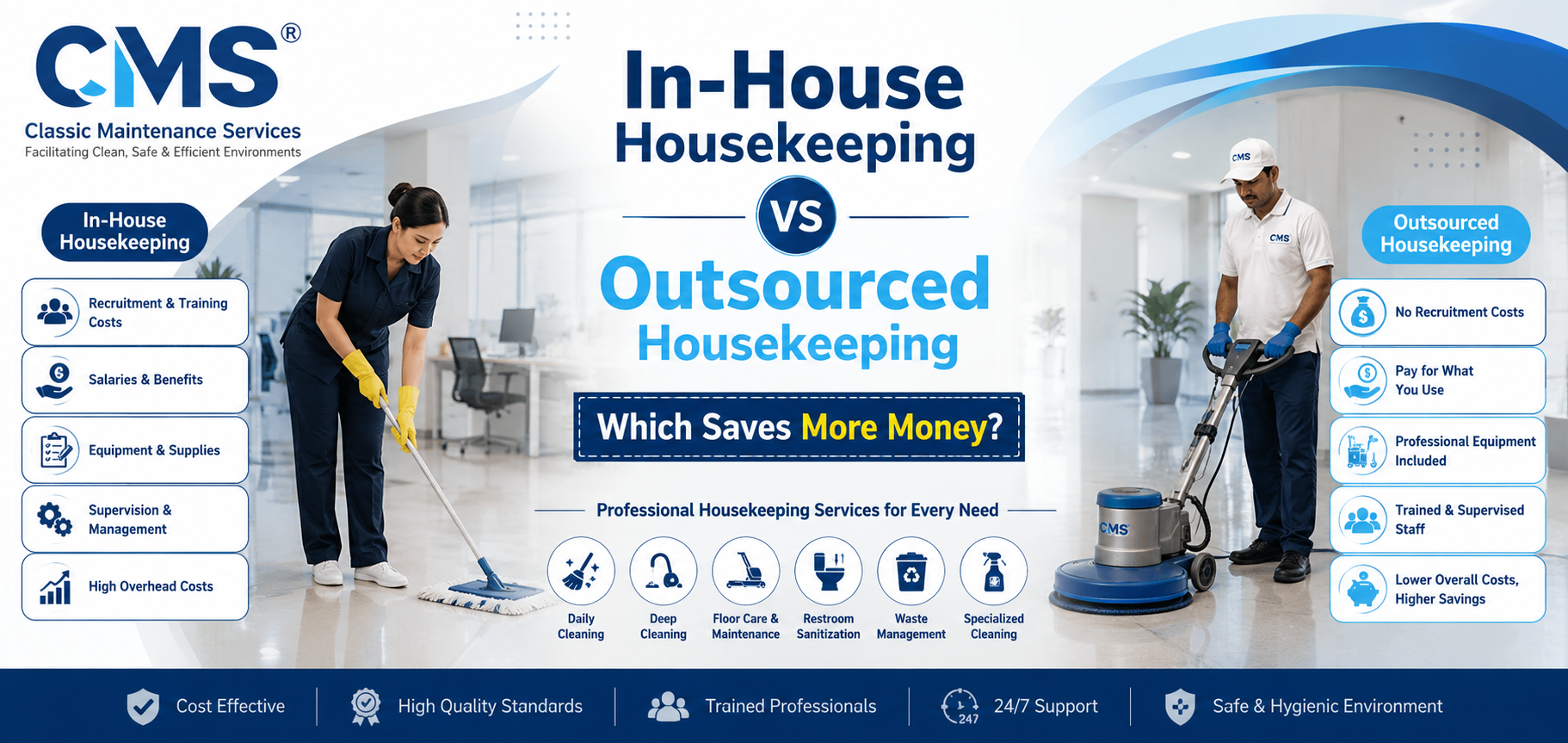
If you manage a facility of any size, you have probably asked yourself this question at least once: should we build our own cleaning team, or bring in housekeeping services from a specialist company? It sounds like a simple choice, but the moment you dig into salaries, equipment, compliance, and supervision, the picture gets complicated fast. Most facility managers in India are quietly overpaying for cleanliness without realizing it, and the gap between what they think they are spending and what they are actually spending can run into lakhs every year.
This blog breaks down the real cost difference between running housekeeping in-house and outsourcing it, using current facility management trends and practical numbers rather than textbook theory. By the end, you will have a clear framework to decide what works best for your building, your budget, and your team.
Why This Question Matters More Than Ever
Commercial rents, compliance costs, and manpower wages have all risen sharply across Indian metros over the last few years. At the same time, tenants and employees expect higher hygiene standards than they did before 2020. This combination has pushed many facility owners to re-examine how they staff their cleaning operations.
A growing number of corporate offices, malls, hospitals, and educational institutes are shifting toward outsourced models, not because in-house teams do a bad job, but because the hidden costs of running an internal department are harder to control. At the same time, some organizations still prefer in-house staff for reasons of direct control and familiarity. Neither approach is wrong, but each comes with a different cost structure that most people never calculate properly.
What “In-House Housekeeping” Actually Costs
On paper, in-house housekeeping looks cheaper. You hire a few staff members, pay their monthly salary, and that is that. In reality, the total cost of ownership includes several line items that rarely show up in the initial budget.
Direct salary costs are only the beginning. Here is where the real cost usually hides.
| Cost Item | Often Missed in Budgeting? | Typical Impact |
| Provident Fund and ESI contributions | Yes | Adds to statutory cost on top of salary |
| Uniforms, ID cards, and safety gear | Yes | Recurring annual expense |
| Cleaning equipment purchase and maintenance | Yes | High upfront and repair cost |
| Consumables (chemicals, mops, machines) | Sometimes | Ongoing monthly spend |
| Sick leave and holiday coverage | Yes | Requires backup staff or overtime pay |
| Recruitment and training time | Yes | Management time cost, rarely quantified |
| Supervisor or manager salary | Sometimes | Needed for daily quality oversight |
When you add these together, in-house housekeeping often costs 20 to 35 percent more than the base salary figure suggests. Many facility managers only discover this when they compare their internal spreadsheet against a vendor quotation for the same scope of work.
There is also the question of accountability. If an in-house staff member is absent, underperforms, or leaves suddenly, the facility manager has to personally manage recruitment, discipline, and replacement. This consumes management bandwidth that could be spent on core business priorities.
What Outsourced Housekeeping Actually Includes
When you outsource to a professional facility management company, you are not just paying for people to show up and clean. You are paying for a system.
A well-run outsourced housekeeping services provider typically bundles in:
- Pre-screened, background-verified staff
- Ongoing training and skill upgrades
- Equipment and machinery already included in the contract
- Supervisory and quality-check layers
- Backup staff for leaves and absences
- Compliance with labour law and statutory payments
- Structured reporting and KPI tracking
Because the vendor spreads its equipment and training costs across multiple clients, the per-client cost is usually lower than what a single facility would pay to replicate the same setup on its own. This is the core financial logic behind outsourcing, and it is why the market for facility management services has grown steadily across Delhi NCR and other major cities.
Comparing the Two Models Side by Side
Instead of theory, here is how the two models typically compare on the factors that matter most to a facility manager.
| Factor | In-House Housekeeping | Outsourced Housekeeping |
| Cost predictability | Fluctuates with attrition, overtime, and unplanned purchases | Usually fixed monthly, making budgeting simpler |
| Staff replacement | Facility manager must personally recruit and train a replacement | Vendor provides a trained replacement, often within 24-48 hours |
| Equipment and technology | Often outdated due to slow internal approval cycles | Regularly updated, since it affects service quality across many clients |
| Compliance risk | Facility owner carries PF, ESI, and minimum wage responsibility | Vendor is contractually responsible for statutory compliance |
| Scalability | Slow to scale up or down for events or expansion | Fast scaling, since vendors keep a trained staffing bench |
| Supervision | Falls informally on the facility manager | Built into the service through daily and periodic inspections |
The Hidden Cost Most People Miss: Supervision
One factor that rarely gets discussed is supervision quality. An in-house housekeeping team without proper daily oversight tends to drift toward inconsistent standards within a few months. Facility managers end up doing informal quality checks themselves, on top of their actual job responsibilities.
Professional housekeeping services providers build supervision directly into their service structure. This typically includes:
- Daily supervisor inspections of assigned areas
- Weekly and monthly quality audits
- Documented corrective action for any lapses
- Periodic client review meetings to track performance
This layered supervision is difficult and expensive to replicate with a small in-house team, especially for facilities that do not have a dedicated administration department.
Current Trends Shaping the Housekeeping Industry
The facility management sector in India has changed noticeably over the past few years, and these shifts are directly relevant to the in-house versus outsourced decision.
Green cleaning is now a client expectation, not a bonus. More corporate tenants and institutions are specifically asking for eco-friendly cleaning chemicals and reduced water usage. Vendors who have already adopted green cleaning programs can offer this without additional cost, while in-house teams often lack access to certified eco-friendly products at competitive rates.
Technology-enabled tracking is becoming standard. Digital checklists, QR-code based inspection logs, and real-time reporting dashboards are increasingly common in outsourced contracts. This level of tracking is expensive to build from scratch for a single facility’s internal team.
ISO-certified processes are a growing differentiator. Facilities that engage vendors following ISO 9001 quality management standards report more consistent service outcomes, since the entire operating system is built around measurable key performance indicators rather than informal supervision.
Specialized services are in higher demand. Requests for facade cleaning, marble polishing, and post-construction cleaning have increased as commercial buildings age and renovation cycles shorten. These are skill-intensive services that most in-house teams are not equipped to perform safely without specialized training and equipment.
When In-House Housekeeping Still Makes Sense
Outsourcing is not automatically the right answer for every facility. In-house housekeeping can still be the better choice when:
- The facility is very small, with limited cleaning scope
- The organization has an existing, loyal team it wants to retain
- There are highly specific security or confidentiality requirements
- Management genuinely has the bandwidth to supervise daily operations
For these situations, a hybrid model often works well. Core daily cleaning stays in-house, while specialized tasks like facade cleaning, deep sanitization, or pest control are outsourced to a professional provider on an as-needed basis.
How Classic Maintenance Services Approaches Housekeeping
Classic Maintenance Services has spent over a decade delivering facility maintenance and cleaning services to corporate offices, manufacturing plants, educational institutions, government facilities, and public venues across the region. The company’s approach is built on a straightforward philosophy: transforming cleanliness, delivering excellence, and promoting health, all within a client’s actual budget rather than a generic package.
What makes the difference is structure. Every housekeeping engagement is backed by daily supervisor inspections, scheduled quality reviews, and a dedicated Facility Services Manager who oversees the transition and ongoing delivery. Operations are standardized using a documented, ISO 9001 aligned quality management system, so performance is tracked through measurable indicators rather than guesswork.
The service scope goes beyond basic sweeping and mopping. It includes sanitization services, waste management, industrial cleaning, building maintenance, post-construction cleanup, and special event cleaning, along with specialized work like facade cleaning, marble polishing, and carpet care. This breadth means a facility does not need to juggle multiple vendors for different cleaning needs.
Client retention is a useful proxy for service quality, and Classic Maintenance Services reports a customer retention rate above 95 percent, which reflects consistent delivery over time rather than a one-time sales pitch.
A Simple Way to Decide for Your Facility
Before finalizing a decision, it helps to ask three direct questions.
First, do you have the internal bandwidth to manage recruitment, training, and daily supervision of cleaning staff? If the honest answer is no, outsourcing removes that burden entirely.
Second, does your facility need specialized services occasionally, such as facade cleaning or deep sanitization? If yes, an in-house team alone will not be enough, and you will end up outsourcing parts of the work regardless.
Third, have you actually calculated your fully loaded in-house cost, including PF, ESI, equipment, and supervision time? Most facilities that make this comparison honestly find that outsourced housekeeping services are either cost-neutral or meaningfully cheaper once every hidden cost is accounted for.
Final Thoughts
There is no universal right answer between in-house and outsourced housekeeping. What matters is looking past the surface-level salary comparison and accounting for equipment, compliance, supervision, and scalability. For most mid-sized and large facilities, outsourcing to an experienced provider ends up being the more predictable and often more economical choice, particularly when specialized services are part of the requirement.
If you are weighing this decision for your own building, a practical next step is to request a scoped quotation from a facility management company and compare it directly against your fully loaded in-house numbers, rather than just the base salary figure.
Frequently Asked Questions
1. Is outsourced housekeeping more expensive than in-house housekeeping?
Not usually. When you account for PF, ESI, equipment, training, and supervision costs, outsourced housekeeping services are often equal to or cheaper than running an internal team of the same size.
2. What is included in a typical housekeeping services contract?
Most contracts include trained staff, cleaning equipment, consumables, supervision, quality reporting, and replacement staff during leaves or attrition.
3. How quickly can an outsourced provider replace an absent staff member?
Reputable facility management companies typically provide backup staff within 24 to 48 hours, since they maintain a trained bench of manpower across multiple sites.
4. Does outsourcing housekeeping reduce legal or compliance risk?
Yes. In an outsourced model, the vendor is generally responsible for statutory compliance such as minimum wage adherence, PF, and ESI, which reduces the facility owner’s direct legal exposure.
5. Can I outsource only specialized services like facade cleaning while keeping daily cleaning in-house?
Yes, this hybrid approach is common. Facilities keep a small in-house team for routine tasks and outsource specialized or infrequent work such as marble polishing or post-construction cleanup.
6. How is quality monitored in an outsourced housekeeping arrangement?
Quality is typically tracked through daily supervisor inspections, weekly and monthly audits, and periodic client review meetings, often supported by documented KPIs.
7. Is green or eco-friendly cleaning available through outsourced providers?
Many established providers now offer green cleaning programs using environmentally friendly chemicals and reduced water consumption as a standard part of their service.
8. What size of facility benefits most from outsourcing?
Mid-sized to large facilities, such as corporate offices, educational campuses, and manufacturing plants, tend to see the clearest cost and management benefits from outsourcing.
9. Does ISO 9001 certification matter when choosing a housekeeping vendor?
It can be a useful indicator of process discipline, since ISO 9001 aligned operations are built around measurable performance standards rather than informal supervision.
10. How often should housekeeping performance be reviewed?
Most professional arrangements include weekly inspections along with quarterly and annual progress reviews to track service quality and address gaps early.
11. What happens if I am not satisfied with an outsourced housekeeping provider?
Most contracts include defined service level agreements and review mechanisms, allowing issues to be raised and corrected through structured escalation rather than informal complaints.
12. Are outsourced housekeeping staff trained for specialized tasks?
Yes, professional providers generally train staff specifically for tasks like facade cleaning, restroom sanitization, and hard floor care, which in-house teams often lack exposure to.
13. Can outsourcing help during sudden facility expansion or events?
Yes, since outsourced providers already maintain a trained staffing bench, they can scale manpower up quickly for expansions or special events without a lengthy hiring cycle.
14. Who handles equipment maintenance in an outsourced housekeeping model?
The vendor typically owns and maintains the cleaning equipment as part of the contract, removing the facility’s need for separate equipment budgeting and upkeep.