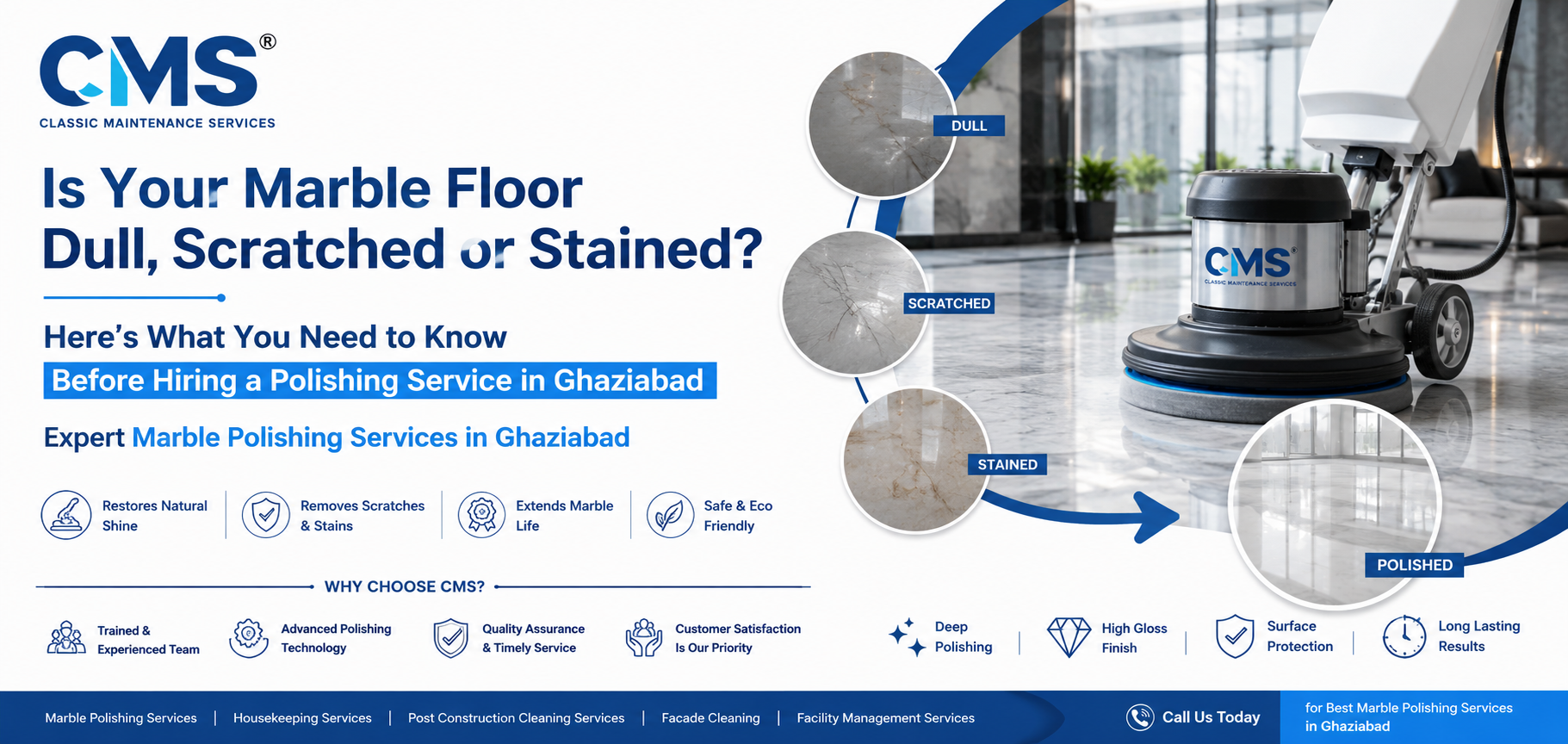
Marble floors are among the most beautiful — and most misunderstood — surfaces in Indian homes and offices. If your floor has lost its shine, you are not alone. Most people searching for marble polishing services in Ghaziabad are dealing with one of three problems: dullness from foot traffic, surface scratches, or stubborn stains that regular mopping hasn’t fixed. This guide walks you through what each problem means, how professionals address it, and what to watch for before you hire anyone.
Why Marble Loses Its Shine Over Time
Marble is a natural stone, which means it is porous and softer than most people assume. Everyday use gradually breaks down its surface.
The Three Main Culprits
- Foot traffic abrasion — Fine grit carried on shoes acts like sandpaper on the surface over time, dulling the polish layer.
- Acidic substances — Lemon juice, vinegar, cleaning products, and even tea can etch marble chemically, leaving dull patches that look like stains but aren’t.
- Hard water deposits — In cities like Ghaziabad where water TDS levels run high, mineral buildup creates a hazy film that regular mopping can’t remove.
Understanding which problem you have matters — because the treatment is different for each.
What Is Marble Polishing, Actually?
Definition: Marble polishing is a multi-step mechanical process that removes a thin layer of the stone’s surface using abrasive pads of progressively finer grits, followed by the application of a crystallising compound or diamond buff to restore optical clarity and shine.
It is not the same as applying a wax coat or a surface spray. Those are temporary fixes. True polishing works on the stone itself.
The Four Stages a Professional Should Follow
Stage 1 — Grinding
Used only when deep scratches, lippage (uneven tile edges), or heavy surface damage is present. A coarse diamond pad removes the damaged layer.
Stage 2 — Honing
Medium-grit pads smooth the surface and prepare it for polishing. This is the stage that removes light scratches and etch marks.
Stage 3 — Polishing
Fine-grit pads and a polishing compound bring the surface to a reflective finish. This is what restores the shine.
Stage 4 — Sealing
A penetrating sealer is applied to close the pores of the stone, making it more resistant to staining and future etching.
A job that skips stages — going straight to polish without honing, for example — will not last.
Types of Marble Commonly Found in Ghaziabad Homes
Not all marble behaves the same way during polishing. Knowing your stone helps you ask better questions.
Italian Marble
- More porous, softer, and more prone to etching
- Requires lower machine speed during polishing to avoid heat damage
- Needs sealing after every polishing cycle
Indian Marble (Makrana, Rajnagar)
- Denser and more forgiving of aggressive treatment
- Still needs proper honing before polishing
Granite (Often Mistaken for Marble)
- Much harder — requires diamond tooling with higher grit numbers
- Does not respond to marble crystallisation compounds
If a vendor doesn’t ask what type of stone you have before quoting, that’s a red flag.
How to Identify Your Problem Before Calling a Vendor
A quick diagnostic test saves time and money.
The Water Drop Test
Pour a few drops of water on the dull area. If the water beads up, the surface seal is intact and the problem is likely surface dirt or hard water deposits. If the water absorbs quickly, the stone is unprotected and needs honing and sealing.
The Scratch Test
Run a fingernail lightly across a scratch. If the nail catches in a groove, it’s a physical scratch that requires honing. If the nail slides over it and only the visual appearance is off, it may be an etch mark from an acid spill.
The Stain Test
Wet the stained area. If the stain temporarily disappears when wet and reappears on drying, it’s likely a sub-surface stain requiring poultice treatment — not just polishing.
Common Mistakes Homeowners Make
Using the Wrong Cleaning Products
Acidic cleaners — including many popular Indian household brands — etch marble surfaces chemically. Even a diluted solution of lemon-based floor cleaner can cause permanent dull patches on Italian marble within weeks.
Delaying Treatment
Surface scratches become structural scratches if ignored. A job that would have cost a fraction of the price in its early stage can require full grinding later.
Hiring Based on Price Alone
When shortlisting marble polishing services in Ghaziabad, cost of materials and machine time is relatively fixed across vendors. A quote significantly below market rate almost always means skipped stages or diluted compounds — and the results show within months.
What to Ask a Marble Polishing Vendor Before Hiring
Questions That Reveal Professionalism
- What type of machines do you use — planetary or single-disc?
- What grit sequence do you follow?
- Do you use dry or wet polishing?
- What sealer do you apply, and what is its durability period?
- Can you share before-and-after work from a similar stone type in Ghaziabad?
A professional will answer these without hesitation. A vendor who gives vague answers like “we use the best machines” has likely not invested in proper equipment or training.
What Good Results Should Look Like
Shine Level (Gloss Reading)
Professional marble polishing achieves a gloss reading of 80–100 GU (Gloss Units) on well-maintained marble and 60–80 GU on older or more damaged surfaces. Some vendors claim “mirror finish” without measuring anything — ask for the actual gloss reading post-job if you want a verifiable result.
Durability
A properly polished and sealed marble floor in a residential setting should retain its finish for 12–18 months under normal use, and 6–9 months in high-traffic commercial areas.
What It Should Not Look Like
- Swirl marks (sign of incorrect machine speed or grit jumping)
- Uneven sheen across tiles (sign of inconsistent pressure or skipped honing)
- White residue in grout lines (sign of compound not cleaned properly)
Marble Polishing Rates Charged by Classic Maintenance Services
One of the most common questions before hiring a professional is: how much will this cost? Classic Maintenance Services offers transparent, process-wise pricing depending on your floor’s condition, age, and the finish you want. Below is a breakdown to help you understand what you are paying for — and why prices differ.
Understanding Old vs. Newly Installed Marble
Pricing differs based on whether your marble is old or newly installed. Old marble typically needs more prep work — cleaning, repair, and multiple honing steps — before polishing can begin. Newly installed marble is flatter and cleaner, but still needs finishing to achieve the right gloss level.
Process 1 — Marble Floor / Tile Cleaning
Rate: Rs. 4 to 6 per sq. ft. (old marble only)
- Machine scrubbing to clean the marble or tile surface
- No polishing involved — this is a deep clean only
- Suitable when the floor is structurally sound but heavily soiled
Process 2 — Spray Buffing Polish
Rate: Rs. 10 to 20 per sq. ft. (old marble only)
- Machine scrubbing followed by spray buffing compound application
- Gives a mild surface sheen — not a full polish
- Best for maintenance between full polishing cycles
Process 3 — Granite Polish (Semi Gloss Finish)
Rate: Rs. 20 to 22 per sq. ft. (old marble) | Rs. 25 to 30 per sq. ft. (new marble)
- Includes floor repair, joint filling, honing, and polishing
- Delivers a semi-gloss finish — clean and presentable, not mirror-like
- Suitable for offices, corridors, and utility areas
Process 4 — Diamond Polish (High Gloss Finish)
Rate: Rs. 30 to 35 per sq. ft. (old marble) | Rs. 40 to 45 per sq. ft. (new marble)
- Includes floor repair, joint filling, multi-step honing, and diamond polishing
- Delivers a high-gloss finish — noticeably reflective and bright
- Recommended for living rooms, lobbies, hotel floors, and premium spaces
Add-On — Epoxy Coating with Diamond Polish (Super Gloss Finish)
Additional Rate: + Rs. 10 per sq. ft. (old and new marble)
What the process involves:
- Honing with 60 grit to open the surface
- Application of epoxy across the entire floor
- Re-honing through 7 to 9 progressive steps
- Crystallization and buffing for a super-gloss finish
This is the highest-quality finish available. Ideal for Italian marble, hotel lobbies, and any surface where appearance is a priority.
Add-On — Silicate Densification
Additional Rate: + Rs. 10 per sq. ft. (old and new marble)
What the process involves:
- Honing with 60 grit followed by epoxy application
- Re-honing through 7 to 9 steps
- Application of stone powder after grit 200 and 800
- Final crystallization and buffing
Definition: Densification is a process where a silicate-based compound penetrates the stone and reacts chemically with calcium in the marble to form a harder, denser surface layer. It increases durability and resistance to wear — useful in high-traffic commercial spaces.
Add-On — Sealer / Stain Protection
Additional Rate: + Rs. 10 per sq. ft. (old and new marble)
- Applied as the final step after polishing
- Penetrates the pores of the stone to block staining agents
- Strongly recommended for kitchens, dining areas, and any marble near water sources
How to Read This Pricing
A few things worth knowing before you get a quote:
- These rates are per square foot and based on the total area to be treated
- Add-ons (epoxy, densification, sealer) are charged on top of the base polish rate
- A heavily damaged floor may need multiple passes, which the on-site assessment will determine
- Getting a site visit before finalising the rate is always the right approach — no two floors are the same
About Classic Maintenance Services
Classic Maintenance Services (CMS) is a Delhi NCR-based facility management company offering marble polishing, floor restoration, facade cleaning, housekeeping, sanitization, and property maintenance across Delhi, Gurgaon, Noida, and Ghaziabad.
CMS has delivered marble polishing and stone care services at properties including Radisson Paschim Vihar, Apollo Hospitals, The Park Hotels, Marriott Jaipur, and The Lalit Jaipur, among others. Their client portfolio also includes McKinsey & Company, JCB, IGI Terminal 3, and the National Institute of Tuberculosis and Respiratory Diseases.
The company’s specialized services division covers marble buffing and polishing, marble grinding and polishing, marble sealing services, marble stain removal, and carpet cleaning — handled by trained teams using professional-grade equipment.
[Insert image of marble polishing service in progress here]
Frequently Asked Questions
1. How often should marble floors be polished professionally?
Residential marble floors in regular use should be professionally polished once every 12 to 18 months. High-footfall commercial spaces — lobbies, hospitals, hotels — typically need polishing every 6 to 9 months to maintain appearance and hygiene standards.
2. Is marble polishing the same as marble cleaning?
No. Marble cleaning removes surface dirt and deposits. Marble polishing is a mechanical process that works on the stone itself to restore its gloss and smoothness. A clean marble floor can still be dull; polishing addresses the surface structure, not just the top layer of dirt.
3. Can scratched marble be fully restored?
In most cases, yes — provided the scratch is surface-level and not a deep crack. Professional honing with diamond abrasive pads removes a thin layer of stone, eliminating the scratch along with it. Very deep gouges may not fully disappear but can be significantly reduced.
4. Why does marble get dull even with regular mopping?
Regular mopping removes surface dirt but doesn’t restore the polished layer that gives marble its shine. Over time, foot traffic, grit, and acidic residue from cleaning products break down that layer. No amount of mopping can reverse this — mechanical polishing is required.
5. What is the difference between marble honing and marble polishing?
Honing uses medium-grit abrasives to create a smooth, flat, matte or satin finish. Polishing takes that honed surface and uses finer grits and compounds to create a high-gloss reflective finish. Most professional marble care services combine both steps.
6. How long does a professional marble polishing job take?
A standard residential room (150–200 sq ft) typically takes 3 to 5 hours. Larger areas, older floors with heavier damage, or floors requiring grinding before polishing will take longer. A serious vendor assesses the floor before giving a time estimate.
7. Can marble polishing remove stains?
It depends on the stain type. Surface stains and etch marks are removed during honing and polishing. Deep sub-surface stains (oil, rust, dye) may require a poultice treatment applied separately before the polishing process begins. Not all stains can be fully removed — a professional will tell you this honestly after inspection.
8. Is wet or dry marble polishing better?
Wet polishing uses water as a coolant during the diamond pad stages, which reduces heat and prevents micro-cracking in the stone. Dry polishing is faster but generates heat that can damage softer marble types like Italian marble. For most Indian homes with imported or Italian marble, wet polishing at the honing stages is safer.
9. Does marble polishing damage the grout?
When done correctly, polishing should not damage grout. However, incorrect technique — too-aggressive machines, wrong compounds, or insufficient masking — can discolour or weaken grout lines. Ask your vendor how they protect grout during the process.
10. How much does professional marble polishing cost in Ghaziabad?
Pricing varies based on the floor area, stone condition, number of stages required, and whether sealing is included. Expect a range broadly based on per-square-foot rates — floors requiring grinding before polishing will cost more than floors needing only a polish refresh. Be cautious of quotes that seem unusually low; they typically indicate skipped stages or diluted materials.
11. Can I use DIY marble polishing kits?
DIY kits can provide a temporary improvement on minor dullness, but they do not replicate the mechanical process of professional polishing. They typically apply a surface coating rather than working on the stone itself, which means the results fade quickly and can leave residue that interferes with future professional work.
12. What should I do to maintain marble after professional polishing?
- Use pH-neutral floor cleaners only
- Place doormats at all entry points to reduce grit
- Wipe spills immediately — especially acidic liquids
- Avoid dragging furniture across the floor
- Schedule a professional maintenance cleaning every 3–4 months between polishing cycles
13. Does marble polishing work on all types of stone floors?
No. The process and compounds used for marble are not appropriate for granite, sandstone, kota stone, or vitrified tiles. Each stone type requires different tooling, grit sequences, and finishing compounds. Always confirm your vendor has experience specifically with your floor type — not just stone floors in general.
Classic Maintenance Services provides professional marble polishing services in Ghaziabad, Noida, Gurgaon, and Delhi. Whether you need marble restoration, marble sealing services, or marble stain removal, the team at CMS handles it all. For a site assessment and quotation, visit classicmaintenance.in