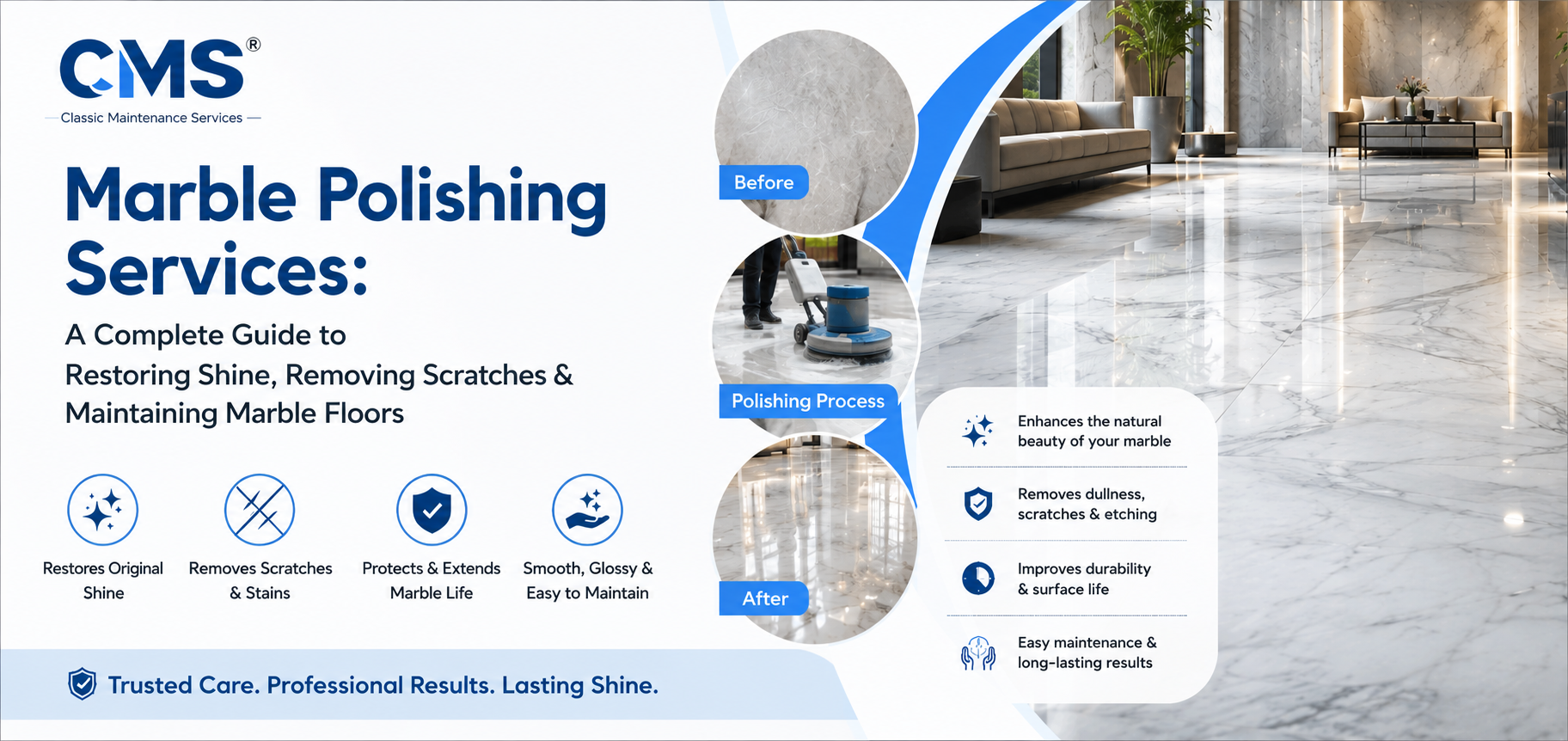
Marble polishing services are professional treatments that restore the natural shine, smoothness, and color depth of marble surfaces that have become dull, scratched, or stained over time. If your marble flooring has lost its sparkle, started showing dull patches, or feels rough underfoot, this guide walks you through everything you need to know — what causes marble to lose its shine, how professional polishing actually works, how it differs from restoration and repair, and how to keep your floors looking their best long after the work is done.
Marble is one of the most beautiful flooring materials available, but it’s also one of the most demanding to maintain. Unlike tile or vinyl, marble is a natural stone that reacts to acids, scratches under abrasive grit, and slowly loses its polish through ordinary foot traffic. Understanding how marble behaves — and how polishing actually restores it — will help you make better decisions about when to call in professionals and how to protect your investment afterward.
What Is Marble Polishing?
Marble polishing is the process of mechanically smoothing and buffing a marble surface to restore its reflective, glass-like finish. It typically involves diamond abrasive pads of progressively finer grits, followed by a polishing compound or crystallization process that brings out the stone’s natural shine.
Polishing works on the surface layer of the marble. It removes light scratches, dullness, and shallow etching caused by everyday wear, but it doesn’t fix deep cracks or structural damage — that falls under restoration and repair, which we’ll cover shortly.
Most homeowners and facility managers don’t notice marble losing its shine gradually; it tends to become obvious only once the contrast between a freshly cleaned area and the rest of the floor becomes visible.
Why Does Marble Eventually Lose Its Shine?
Marble is composed mainly of calcium carbonate, which makes it soft compared to granite or engineered stone and highly reactive to acidic substances. Several everyday factors contribute to marble losing its polish:
- Foot traffic and grit — Sand, dust, and small stones tracked in from outside act like sandpaper, creating thousands of microscopic scratches that scatter light instead of reflecting it.
- Acidic spills — Common household items like lemon juice, vinegar, wine, coffee, and even some cleaning products contain acids that etch marble on contact, leaving dull spots that won’t buff out with regular cleaning.
- Incorrect cleaning products — Many all-purpose cleaners and floor cleaners are acidic or abrasive, and using them on marble gradually strips the polished surface.
- Heavy furniture and equipment — Dragging furniture or rolling heavy equipment across marble can leave scratches and scuff marks.
- UV exposure — In areas with direct sunlight, prolonged UV exposure can affect certain marble varieties, causing subtle discoloration over time.
- Age and natural wear — Even with careful maintenance, marble’s surface gradually wears down simply through years of use.
None of this means marble is a poor flooring choice — it simply means it needs periodic professional attention to keep performing the way it did on day one.
Signs Your Marble Floor Needs Polishing
It helps to know what to look for before damage becomes harder to reverse. Common indicators include:
- Dull or hazy patches that don’t disappear after mopping or cleaning
- Loss of reflection — you can no longer see a clear reflection in the surface
- Visible scratches, especially in high-traffic walkways or under furniture
- Etch marks from spills, often appearing as light, dull rings or spots
- Uneven sheen across the floor, where some areas look glossy and others look flat
- Rough or gritty texture when you run your hand across the surface
- Stains that won’t lift with regular mopping
If you’re noticing two or more of these signs, it’s usually a good time to schedule professional marble polishing services rather than waiting for the damage to spread.
Types of Marble Polishing and Restoration Treatments
Not every marble problem needs the same fix. Professional providers typically offer a range of treatments depending on the floor’s condition:
- Diamond polishing — Uses diamond abrasive pads in progressively finer grits to smooth and shine the surface. Best for general dullness, light scratching, and routine shine restoration.
- Crystallization — Applies a chemical treatment that reacts with the marble surface to create a hard, glossy, mirror-like finish. Best for high-traffic commercial floors needing long-lasting gloss.
- Grinding and leveling — Removes uneven surfaces, lippage (uneven tile edges), and deeper scratches through mechanical grinding. Best for floors with structural unevenness or heavy wear.
- Honing — Creates a smooth matte or satin finish rather than a glossy one. Best for floors where a non-reflective, low-maintenance look is preferred.
- Sealing — Applies a protective coating that resists stains, moisture, and spills. Best for protecting freshly polished marble and reducing future etching.
- Crack and chip repair — Fills and blends cracks, chips, or pitting using color-matched fillers. Best for localized physical damage rather than general dullness.
A good provider will usually inspect the floor first and recommend a combination of these treatments rather than a one-size-fits-all approach.
How Professional Marble Polishing Works: Step by Step
While the exact process varies slightly between providers, most professional marble polishing services follow a similar sequence:
- Inspection and assessment — The technician examines the marble type, the extent of dullness or damage, and identifies any cracks, stains, or uneven areas that need attention before polishing begins.
- Deep cleaning — The floor is thoroughly cleaned to remove dust, grit, and surface debris. Skipping this step would trap particles under the polishing pads and create new scratches.
- Repair work (if needed) — Cracks, chips, or pitted areas are filled and leveled so the surface is uniform before grinding or polishing starts.
- Grinding (if required) — For floors with deep scratches, lippage, or unevenness, coarse diamond grits are used first to level the surface.
- Progressive diamond polishing — The floor is buffed using diamond pads in a sequence from coarse to fine grit. Each pass removes smaller imperfections left by the previous one, gradually building up the shine.
- Crystallization (optional) — For an extra-glossy, hard-wearing finish, a crystallization compound may be applied and buffed in, which also strengthens the surface against future wear.
- Sealing and protection — A penetrating or topical sealant is applied to help resist future staining and moisture absorption.
- Final inspection and buffing — The floor is given a final buff and checked under different lighting to confirm an even, consistent shine across the entire surface.
This entire process can take anywhere from a few hours for a small residential area to several days for large commercial spaces, depending on floor condition and square footage.
Marble Polishing vs. Marble Restoration vs. Marble Repair
These terms are often used interchangeably, but they refer to different levels of intervention:
- Marble polishing — Purpose: restores shine and smoothness. Typically addresses dullness, light scratches, and uneven sheen. Involves light to moderate grinding and buffing. Usually needed every 1–3 years depending on traffic. Outcome: renewed shine and a smooth feel underfoot.
- Marble restoration — Purpose: brings a heavily damaged floor back to near-original condition. Typically addresses deep scratches, extensive staining, structural unevenness, and years of neglect. Often combines grinding, leveling, crack filling, and polishing in a single project. Usually a one-time deep intervention rather than a routine job. Outcome: the floor looks close to newly installed.
- Marble repair — Purpose: fixes specific physical damage. Typically addresses cracks, chips, pitting, and broken edges. Involves filling and color-matching, sometimes followed by spot polishing. Carried out as needed, whenever damage occurs, rather than on a schedule. Outcome: damage is no longer visible or structurally weak.
If your floor only looks dull, polishing alone is usually enough. If it has visible cracks, deep gouges, or hasn’t been treated in many years, restoration is the more appropriate (and longer-lasting) option.
DIY Marble Polishing vs. Professional Marble Polishing Services
Many people attempt to polish marble themselves using store-bought polishing powders or marble-specific cleaning kits. It’s worth understanding the trade-offs before deciding which route to take.
- Equipment — DIY relies on hand pads and basic polishing powder; professionals use industrial diamond polishing machines with calibrated grits.
- Risk of damage — DIY carries a higher risk, since incorrect pressure or product choice can etch or scratch the surface further; professionals know how to match technique to marble type, which lowers that risk.
- Result longevity — DIY shine tends to be temporary and often fades within weeks; professional work produces a longer-lasting finish, especially when combined with crystallization and sealing.
- Time investment — DIY can mean hours of manual effort, often repeated; professional teams complete the job efficiently with proper machinery.
- Best suited for — DIY works well for small touch-ups and light maintenance buffing; professional polishing is better suited to whole-room or whole-building floors, visible damage, and commercial spaces.
- Cost — DIY has a lower upfront cost; professional polishing costs more upfront but generally offers better value over time.
DIY polishing kits can help maintain shine between professional treatments, but they generally can’t correct etching, deep scratches, or uneven surfaces the way diamond grinding and crystallization can.
How to Get Rid of Stains and Scratches on Marble
Scratches and stains are the two most common complaints with marble floors, and they need slightly different approaches.
Light surface scratches:
- Clean the area thoroughly first to rule out dirt that’s simply mimicking a scratch
- Light scratches can often be buffed out using a marble polishing powder and a soft cloth or buffing pad
- Deeper scratches usually require diamond grinding, which should be left to professionals to avoid creating an uneven patch
For stains:
- Identify whether the stain is organic (coffee, wine, food) or oil-based (grease, cooking oil), since the removal approach differs
- Organic stains often respond to a mild hydrogen peroxide-based poultice left on the area for several hours
- Oil-based stains typically need an absorbent poultice paste designed to draw the oil out of the porous stone
- Avoid vinegar, lemon-based cleaners, or any acidic product, as these will etch the marble further rather than clean it
Etch marks (dull spots from acidic spills):
- These aren’t technically stains — they’re surface damage — so cleaning alone won’t fix them
- Etch marks generally need light buffing or polishing to restore the smooth, reflective surface
If a stain or scratch persists after trying these steps, it’s a sign the damage has gone deeper than surface level, and professional marble polishing services will likely be needed to fully restore the finish.
How Often Should You Polish Marble Floors?
The right frequency depends heavily on how much traffic the floor sees:
- High-traffic commercial spaces (malls, hotel lobbies, showrooms): every 6–12 months
- Office spaces and retail stores: roughly once a year
- Residential floors in busy areas (entryways, kitchens, living rooms): every 1–2 years
- Residential floors in low-traffic areas (bedrooms, formal rooms): every 2–3 years
Routine maintenance — daily dust mopping, using pH-neutral cleaners, and promptly wiping up spills — can extend the time between professional polishing sessions significantly.
What Affects the Cost of Marble Polishing Services?
Pricing for marble polishing varies based on several factors, so it’s worth understanding what drives the cost before requesting quotes:
- Floor area — Larger spaces generally cost less per square foot than small jobs, due to setup and equipment time
- Condition of the marble — A floor needing grinding and crack repair will cost more than one needing a routine buff
- Type of marble — Some marble varieties are softer or more porous and require more careful handling
- Treatment selected — Crystallization and sealing add to the cost compared to basic polishing alone
- Accessibility — Furniture removal, stairs, or tight spaces can affect labor time
- Location and travel — Service charges can vary depending on how far the team needs to travel
Because of these variables, it’s best to get a floor inspected in person rather than relying on a flat quote sight unseen.
How to Maintain Marble Floors After Polishing
A fresh polish can last much longer with the right ongoing care:
- Dust mop daily in high-traffic areas to prevent grit from scratching the surface
- Use pH-neutral, marble-safe cleaners — never anything labeled as a general bathroom or kitchen cleaner unless it specifically states it’s safe for natural stone
- Wipe up spills immediately, especially anything acidic like citrus, wine, or vinegar-based dressings
- Use felt pads under furniture legs to prevent scratches when items are moved
- Avoid dragging heavy objects across the floor — lift and carry instead
- Reapply sealant periodically, typically once a year for high-traffic areas, to maintain stain resistance
- Avoid steam cleaners and vinegar-based “natural” cleaning hacks, both of which can damage the polished surface over time
These habits won’t replace professional polishing entirely, but they will noticeably extend the time between treatments.
Common Mistakes That Damage Marble Floors
Many marble problems aren’t caused by age alone — they’re caused by well-intentioned but incorrect care. Avoiding these common mistakes can significantly slow down how quickly a floor loses its polish:
- Using vinegar or lemon-based “natural” cleaning solutions — These are popular online for general cleaning, but they’re acidic and will etch marble almost immediately, even with light use.
- Mopping with a dirty mop or bucket — If the mop water contains grit or sand from earlier use, you’re effectively dragging sandpaper across the floor every time you clean.
- Skipping doormats at entrances — A large share of the grit that scratches marble comes from outdoor dirt tracked in on shoes. Mats at every entry point reduce this significantly.
- Using bleach or ammonia-based cleaners — These can discolor marble over time and break down sealants faster than expected.
- Ignoring small spills — A wine or coffee spill left for even 30 minutes can etch noticeably more than one wiped up within a minute.
- Over-polishing with home kits — Repeated use of consumer polishing powders without addressing the underlying cause of dullness can sometimes create uneven sheen across the floor.
- Delaying professional attention — The longer dullness or etching is left untreated, the more aggressive (and costly) the eventual grinding or restoration process tends to be.
Most of these mistakes are easy to fix once you’re aware of them, and correcting them alone can meaningfully extend the life of a polish job.
Marble Polishing for Homes vs. Commercial Spaces
The right approach to marble polishing often depends on where the floor is and how it’s used:
Residential floors tend to see lighter, more localized wear — entryways, kitchens, and staircases usually show damage well before bedrooms or formal living areas. For homes, polishing is often scheduled around visible dullness rather than a fixed calendar, and a glossier finish is usually preferred for living spaces.
Commercial floors — in hotels, malls, showrooms, and office lobbies — face far higher foot traffic, more frequent spills, and greater exposure to outdoor grit. These spaces typically benefit from scheduled, calendar-based polishing (rather than waiting for visible dullness) and often use crystallization for a harder, more traffic-resistant finish that holds up better under continuous use. Larger commercial properties also tend to phase the work area by area to avoid shutting down an entire space at once.
In both cases, the underlying process is similar — inspection, cleaning, grinding if needed, diamond polishing, and sealing — but the scheduling, finish type, and scale of the work differ considerably.
How to Choose a Marble Polishing Service Provider
If you’ve decided professional help is the right move, a few things are worth checking before booking:
- Experience with your specific marble type — Marble varieties differ in hardness and porosity, and an experienced team will adjust their approach accordingly
- Equipment used — Diamond polishing machines and proper grit sequences produce far better, longer-lasting results than manual buffing alone
- Before-and-after examples — Reputable providers are usually able to show real examples of completed work
- Clear process explanation — A provider who explains what they’ll do (inspection, grinding if needed, polishing, sealing) is generally more transparent than one offering a vague “we’ll make it shine” promise
- Transparent pricing — Ask whether the quote includes inspection, repair work, sealing, and follow-up if needed
Companies that have worked across many properties — residential, commercial, and institutional — tend to have encountered a wider range of marble conditions and are better equipped to judge which treatment a particular floor actually needs. For reference, providers like Classic Maintenance Services, which has worked on marble flooring across Delhi NCR for over two decades, typically combine inspection, grinding, crystallization, and sealing depending on what each floor requires, rather than applying the same treatment to every job.
What Clients Say
Here’s some feedback from organizations that have worked with Classic Maintenance Services on their facility upkeep:
“My experience with Classic Maintenance Services has been great. The employees conduct themselves with the highest level of professionalism, knowledge, and commitment to quality. CMS responded to my needs within an hour, they …” — Radisson Paschim Vihar
“I would like to express my pleasure in regard to the quality service that we have consistently received from your company. We have always the transparent and clean dealing, a quick response that …” — Apollo Hospitals
“From the day we had engaged CMS, we had found them self-driven, focused, and quality-oriented during the entire process. The work was completed within the planned time. The attitude of the persons was …” — National Institute Of Tuberculosis And Respiratory Diseases
“We would like to appreciate your effort and dedication towards the monthly audit and compliance part, advancing to excellent score on the preliminary audit. We expect the same spirit to maintain and continue …” — Radisson Guwahati
Frequently Asked Questions
Does marble polishing remove all scratches? Light surface scratches are usually removed during polishing. Deeper scratches may need grinding first, which is typically included as part of a more thorough restoration rather than a basic polish.
Is marble polishing safe for all marble colors and types? Most marble varieties can be safely polished, but softer or more porous types need gentler grit sequences and extra care during the process. A professional inspection beforehand helps avoid unsuitable techniques.
How long does a marble polishing job take? A single room can often be completed within a few hours, while large commercial floors may take one to several days depending on size and condition.
Can I walk on the floor immediately after polishing? It’s best to avoid walking on the floor until any sealant or crystallization compound has fully cured, which is usually a few hours, though exact timing depends on the products used.
Will polishing fix etch marks from spills? Yes, in most cases. Etch marks are surface-level damage, and buffing or polishing typically restores the smooth, reflective finish in the affected area.
How is crystallization different from regular polishing? Crystallization uses a chemical reaction to harden and gloss the surface, producing a more durable, mirror-like shine compared to mechanical polishing alone, which relies purely on abrasion and buffing.
Do I need to seal marble after polishing? Sealing isn’t strictly required, but it’s strongly recommended, since it adds a protective layer against stains and moisture, helping the polished finish last considerably longer.
Final Thoughts
Marble floors are an investment worth protecting, and most of the dullness, scratching, and staining that builds up over time is entirely reversible with the right approach. Understanding the difference between polishing, restoration, and repair — and knowing which signs point to which treatment — makes it much easier to have the right conversation with a service provider and avoid paying for more (or less) work than your floor actually needs.
Whether you’re maintaining a single living room floor or managing marble across a large commercial property, the combination of timely professional treatment and consistent day-to-day care is what keeps marble looking the way it was meant to look: clean, smooth, and genuinely reflective.