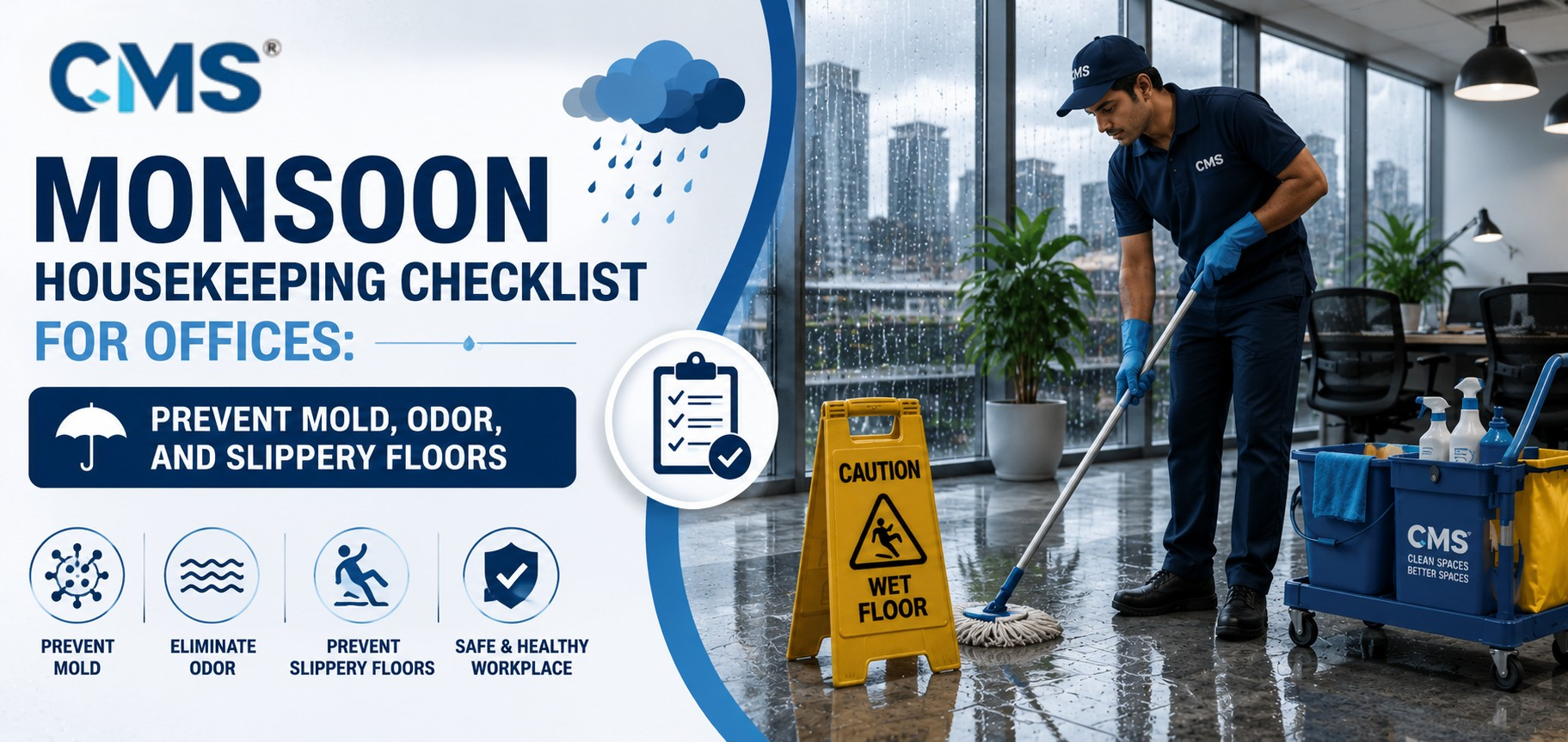
Reliable housekeeping services make the difference between a safe, healthy workplace and a monsoon-damaged one, because rain months bring damp corners, musty smells, and wet floors that standard daily cleaning routines can’t handle. This guide breaks down a complete monsoon housekeeping checklist for offices — covering mold prevention, odor control, and slip-and-fall safety — along with a day-by-day cleaning schedule, the right tools for humid conditions, and answers to the questions facility managers ask most often during India’s rainy season. Whether you manage an in-house janitorial team or outsource to a professional vendor, the goal stays the same: keep the workplace dry, breathable, and safe from June through September.
Why Monsoon Season Is Different for Office Cleaning
Most office cleaning schedules are built around dust, footfall, and everyday spills. Monsoon changes the equation entirely. Humidity levels in North Indian cities like Delhi, Noida, Gurgaon, and Ghaziabad regularly climb above 80% during peak rain months, and that moisture doesn’t stay outside.
Three problems show up almost every monsoon in commercial spaces:
- Trapped moisture in carpets, upholstery, false ceilings, and AC ducts, which becomes a breeding ground for mold and mildew within 24–48 hours if untreated.
- Persistent damp odor in enclosed areas like server rooms, basements, storage rooms, and washrooms, caused by poor ventilation combined with rising humidity.
- Wet, slippery flooring near entrances, lobbies, and staircases, which is one of the leading causes of workplace slip-and-fall incidents during the rainy season.
None of these are cosmetic issues. Mold exposure is linked to respiratory irritation and allergic reactions, damp odor affects client impressions the moment someone walks through the door, and wet floors create real liability risk for facility managers. A monsoon-specific housekeeping plan addresses all three before they become bigger, costlier problems.
The Core Monsoon Housekeeping Checklist for Offices
Use this as a working checklist for your facilities or housekeeping team. It’s organized by cleaning frequency so nothing falls through the cracks during the busiest weeks of the season.
| Task | Frequency | Why It Matters |
|---|---|---|
| Mop entrance and lobby floors with anti-slip solution | Multiple times daily | Rainwater tracked in from outside is the #1 slip hazard |
| Place absorbent mats at all entry points | Daily check, weekly deep-clean | Reduces water carried onto main flooring |
| Inspect false ceilings and corners for damp patches | Daily | Early mold detection before spores spread |
| Wipe down window sills and glass frames | Daily | Prevents water pooling and seepage into walls |
| Deep-clean washrooms with disinfectant | Daily | Humidity accelerates bacterial growth in wet areas |
| Vacuum carpets and upholstery with HEPA filter vacuum | 2–3 times weekly | Removes trapped moisture and allergens |
| Check and clean AC filters and vents | Weekly | Prevents mold spores from circulating through HVAC |
| Inspect drainage points and gutters near entrances | Weekly | Blocked drains cause water accumulation at doorways |
| Use dehumidifiers in server rooms and basements | Ongoing during monsoon | Keeps electronics and storage areas below 60% humidity |
| Sanitize door handles, railings, and lift buttons | Daily | High-touch points collect more bacteria in humid air |
| Air out storage rooms and cabins | Weekly | Reduces musty odor buildup in closed spaces |
| Inspect facade and exterior walls for seepage | Monthly | Early sign of water damage before interior mold appears |
| Deep-clean carpets professionally | Monthly | Surface cleaning alone doesn’t remove trapped monsoon moisture |
How to Prevent Mold Growth in Offices During Monsoon
Mold needs three things to grow: moisture, warmth, and an organic surface to feed on — office carpets, ceiling tiles, and wooden furniture provide all three during monsoon. Prevention works best when it’s proactive rather than reactive.
1. Control humidity, don’t just clean visible dampness. Ideal indoor humidity for offices sits between 40–60%. Anything above that for extended periods creates conditions mold thrives in, even if surfaces look dry. Dehumidifiers in enclosed rooms — server rooms, basements, storage areas — make a measurable difference.
2. Address leaks immediately, not on the next maintenance cycle. A slow ceiling leak that goes unnoticed for a week can lead to visible mold growth within days. Daily visual inspection of ceiling corners, near windows, and around AC units should be part of the housekeeping routine, not a separate maintenance task.
3. Ventilate enclosed spaces regularly. Rooms without windows — storage cabins, server rooms, some washrooms — need forced ventilation or exhaust fans running consistently during monsoon, since stagnant humid air is exactly what mold spores need to settle and multiply.
4. Use antimicrobial cleaning agents in high-risk zones. Standard floor cleaners don’t address mold spores already present in grout lines, carpet fibers, or upholstery seams. Antimicrobial and mold-inhibiting solutions should be used weekly in washrooms, pantry areas, and carpeted zones during the rainy months.
5. Don’t ignore fabric and soft furnishings. Office chairs, sofas in reception areas, and curtains absorb ambient moisture even without a direct leak. Professional upholstery cleaning during monsoon isn’t just about appearance — it’s about removing the moisture those fabrics have been holding onto for weeks.
Tackling Damp Odor in Office Spaces
Damp odor is usually the first sign something’s wrong before mold becomes visible. A few doable solutions have a significant impact:
- Run exhaust fans in washrooms and pantries continuously during working hours, not just when someone’s using the space.
- Keep enclosed cabins and storage rooms open for airflow during non-working hours whenever security allows it.
- Use activated charcoal or odor-neutralizing agents in closed cupboards, drawers, and storage units — these absorb moisture-linked odor rather than masking it with fragrance.
- Clean and dry floor traps and drain outlets weekly; stagnant water in traps is a common, overlooked odor source.
- Avoid over-reliance on air fresheners, which mask odor temporarily without addressing the underlying moisture problem.
Preventing Slippery Floors and Workplace Accidents
Wet flooring is the most immediate safety risk offices face during monsoon, and it’s also the easiest to prevent with consistent housekeeping discipline.
Entrance zones need the most attention. Every person walking in during rain brings water with them, which means the first 10–15 feet of flooring inside any entrance needs continuous monitoring, not a single morning mop.
A simple, effective system:
- Place high-absorbency mats immediately inside every entry point, and replace or wring them out multiple times a day.
- Put up visible “wet floor” signage near entrances and staircases during and immediately after rain.
- Assign a team member to check and dry entrance flooring at set intervals — not just when it looks obviously wet.
- Use slip-resistant floor treatments on marble, tile, and stone flooring, especially in lobbies and staircases where the risk of injury is highest.
- Keep staircases and ramps dry and well-lit, since reduced visibility during monsoon rain compounds the slip risk.
Daily, Weekly, and Monthly Monsoon Cleaning Schedule
| Schedule | Key Tasks |
|---|---|
| Daily | Mop entrances, refresh mats, sanitize high-touch points, disinfect washrooms, inspect for new damp patches, empty floor traps |
| Weekly | Vacuum carpets and upholstery, clean AC filters, inspect drainage, air out closed rooms, deep-clean washroom tiles and grout |
| Monthly | Professional carpet cleaning, facade inspection for seepage, deep sanitization of pantry and washroom fittings, HVAC duct check |
Sticking to a schedule like this removes the guesswork and makes accountability easier — everyone from the housekeeping supervisor to the facility manager knows exactly what should be done and when.
Why Professional Housekeeping Services Matter More During Monsoon
In-house cleaning teams often manage daily upkeep well, but monsoon introduces problems that need specialized handling — humidity control, antimicrobial treatment, facade seepage checks, and deep carpet extraction that go beyond routine mopping and dusting. This is where experienced housekeeping services add real value, since teams trained specifically for seasonal challenges know how to spot early signs of dampness before they turn into mold, and how to treat high-risk zones like washrooms and server rooms without disrupting daily office operations.
Classic Maintenance Services has spent over a decade working across corporate offices, commercial buildings, and institutional facilities in Delhi NCR, and one pattern holds true every monsoon: the offices that stay mold-free and odor-free are the ones with a documented seasonal checklist, not just a good cleaning staff. That’s the principle this guide is built around — a system, not just effort.
Tools and Products That Actually Help During Monsoon
Not all cleaning equipment performs well in high-humidity conditions. A few things worth prioritizing:
- HEPA-filter vacuum cleaners — trap fine moisture-laden dust and allergens instead of redistributing them.
- Microfiber mops and cloths — absorb more moisture per pass than cotton alternatives, reducing residual dampness on floors and surfaces.
- Dehumidifiers — essential for server rooms, basements, and any enclosed space without natural ventilation.
- Antimicrobial and mold-inhibiting cleaning solutions — necessary for grout, carpet fibers, and upholstery seams where standard cleaners fall short.
- Slip-resistant floor treatments — applied to marble, tile, or stone flooring in high-traffic monsoon zones.
- Industrial-grade wet-dry vacuums — useful for quickly clearing standing water near entrances after heavy rain.
Common Monsoon Housekeeping Mistakes Offices Make
Even offices with a regular cleaning routine run into avoidable problems every monsoon. Recognizing these mistakes early saves both money and health risk later in the season.
- Waiting for visible mold before acting. By the time mold is visible on a wall or ceiling, spores have usually already spread to nearby areas. Daily inspection catches dampness at the “musty smell” stage, well before it becomes a visible patch.
- Treating monsoon cleaning as an extension of regular cleaning. Using the same products and frequency as the rest of the year underestimates how fast humidity changes conditions indoors. Monsoon needs its own checklist, not an extra pass with the same routine.
- Overlooking storage rooms and cabins. These spaces get cleaned less often simply because fewer people use them daily, but that also means dampness and odor go unnoticed the longest.
- Relying only on fragrance to manage odor. Air fresheners cover a smell temporarily but don’t remove the moisture causing it, so the odor returns — often stronger — within a day or two.
- Skipping facade and drainage checks until a leak appears. A blocked external drain or a hairline crack in the facade can quietly let water into the building for weeks before anyone notices the interior damage.
- Under-preparing entrances. A single mat at the door isn’t enough for offices with moderate to high footfall during active rain; entrances need continuous monitoring, not a one-time setup.
The Real Cost of Skipping Monsoon Housekeeping
Neglecting monsoon-specific housekeeping doesn’t just create a less pleasant workplace — it has measurable downstream costs that facility managers often underestimate until they show up on a budget sheet.
| Neglected Area | Likely Consequence | Typical Cost Impact |
|---|---|---|
| Damp carpets and upholstery | Mold growth, replacement needed | Full carpet or furniture replacement instead of a routine deep-clean |
| Untreated washroom moisture | Bacterial buildup, employee health complaints | Increased sick leave, complaints to HR/facilities |
| Wet, unmarked flooring | Slip-and-fall injuries | Medical costs, potential liability claims |
| Ignored facade seepage | Structural water damage over time | Expensive repair or repainting work |
| Poor ventilation in server rooms | Equipment corrosion, hardware failure | IT equipment repair or replacement |
Looked at this way, a documented monsoon housekeeping checklist isn’t an added expense — it’s a way of avoiding costs that are far higher than the cleaning itself.
Building an Office Culture Around Monsoon Readiness
Housekeeping teams can only do so much if the rest of the office isn’t cooperating. A few simple habits, communicated to employees at the start of monsoon season, make the entire system work better:
- Ask employees to use umbrella stands and shoe-drying mats near entrances instead of carrying wet umbrellas and footwear directly to their desks.
- Encourage reporting of leaks or musty smells immediately rather than waiting for the next scheduled inspection — employees often notice a problem in their section before the housekeeping team does.
- Keep desks and cabins reasonably clutter-free so cleaning staff can access corners, vents, and skirting boards where dampness tends to collect first.
- Communicate the monsoon schedule internally so employees understand why certain areas might be closed briefly for deep cleaning or drying.
None of this requires a large initiative — it simply means treating monsoon readiness as a shared responsibility rather than something that happens invisibly in the background.
Frequently Asked Questions
1. How often should office floors be mopped during monsoon?
Entrance and lobby areas should be mopped multiple times a day during active rain, while the rest of the office floor typically needs mopping once or twice daily depending on footfall.
2. What causes mold to grow in offices during monsoon?
Mold grows when trapped moisture combines with warmth and an organic surface — carpets, ceiling tiles, wooden furniture — creating ideal conditions within 24 to 48 hours if the area isn’t ventilated or dried.
3. Can air conditioning make monsoon dampness worse?
Yes, if AC filters and vents aren’t cleaned regularly, they can circulate mold spores and trapped moisture throughout the office rather than reducing humidity.
4. What’s the ideal indoor humidity level for an office?
Between 40% and 60%. Levels consistently above that range create favorable conditions for mold and bacterial growth.
5. How do I remove musty odor from an office without air fresheners?
Improve ventilation with exhaust fans, use activated charcoal in closed storage areas, clean drain traps regularly, and address the moisture source directly rather than masking the smell.
6. Are wet floor mats enough to prevent slips during monsoon?
Mats help but aren’t sufficient alone — they need to be checked and replaced frequently, paired with slip-resistant floor treatments and clear signage near entrances.
7. How often should office carpets be professionally cleaned during monsoon?
Monthly professional deep-cleaning is recommended, in addition to vacuuming two to three times a week, since surface vacuuming doesn’t remove moisture trapped deep in carpet fibers.
8. What areas of an office are most at risk for mold during monsoon?
Server rooms, basements, storage cabins, false ceilings, washrooms, and any enclosed space with limited airflow are the highest-risk zones.
9. Should offices use dehumidifiers year-round or only during monsoon?
Dehumidifiers are most critical during monsoon months, particularly in enclosed spaces without natural ventilation, though some facilities in consistently humid regions use them year-round.
10. How can facade seepage affect indoor office cleanliness?
Water seeping through exterior walls during heavy rain can lead to interior damp patches and mold growth, which is why monthly facade inspection is part of a complete monsoon housekeeping checklist.
11. What’s the difference between regular office cleaning and monsoon-specific housekeeping?
Regular cleaning focuses on dust and daily upkeep, while monsoon housekeeping adds humidity control, antimicrobial treatment, drainage checks, and slip-prevention measures specific to rain-related risks.
12. Do small offices need the same monsoon checklist as large commercial buildings?
The core principles — moisture control, ventilation, and slip prevention — apply regardless of size, though the frequency and scale of tasks like carpet cleaning or dehumidifier placement will vary.
13. When should an office bring in professional housekeeping services for monsoon preparation?
Ideally before the season starts, so facade checks, drainage inspection, and deep carpet cleaning are completed proactively rather than in response to visible damage once the rains have already set in.
Final Thoughts
Monsoon doesn’t have to mean mold, odor, or accident risk in office spaces — it means the cleaning routine needs to adapt for a few months a year. A documented checklist, the right tools, and consistent execution across daily, weekly, and monthly tasks cover most of what any facility needs. For offices without the internal bandwidth to manage all of this alongside daily operations, working with housekeeping services that already have a seasonal system in place — like the checklist outlined above — tends to be the more reliable route through the rainy months.